

Dale Robertson

Dale Robertson

Ronald Bergan’s “Guardian” obituary:

In Hollywood, in the days when men were men, Dale Robertson, who has died aged 89, was considered the epitome of masculinity. In the Clarion Call episode from O Henry’s Full House (1952), a giggling, snivelling crook, played by Richard Widmark, whom Robertson, a cop, has come to arrest, keeps calling him “the beeg man”. Robertson, an ex-prize fighter, was indeed “beeg” – tall, well-built and ruggedly handsome, with a gravelly voice. He was tough but fair to men, and courteous to ladies, particularly in the many westerns in which he starred in the 1950s, and in his most famous role, that of special investigator Jim Hardie in the TV series Tales of Wells Fargo.

He was born Dayle Lymoine Robertson, in Harrah, Oklahoma, and attended Oklahoma Military Academy, Claremore, where he was named “all around outstanding athlete”. During the second world war, he served with Patton’s Third Army, winning bronze and silver stars, before having his knee shattered by German mortar fire. He claimed that, had it not been for this injury, he would have pursued a professional boxing career.

When Robertson was stationed in California, he had his photograph taken to send to his mother. The photographer liked the picture so much that he enlarged it and put in his window. It was seen by talent agents, who contacted Robertson.

Without ever having acted, or taken a lesson, Robertson made for Hollywood in 1946, but it took two years before he was given a few small roles at various studios, one as a lifeguard in The Girl from Jones Beach (1949). Then Nat Holt, producer of westerns, cast him as Jesse James in Fighting Man of the Plains (1949). It was a small role, but Robertson got to rescue Randolph Scott from the gallows at the last minute, and was offered a long-term contract with 20th Century Fox.

He was given a supporting role as a hardened soldier in Robert Wise’s civil-war western Two Flags West (1950), and Fox decided to try him in a couple of musicals in 1951: Call Me Mister, starring Betty Grable, in which he played a doting soldier; and Golden Girl, in which he co-starred with Mitzi Gaynor, he as a Confederate spy, she a Yankee showgirl.

He got his first top billing in Return of the Texan (1952), and subsequently settled down to being a cowboy hero in a number of competently made westerns at Fox, often co-starring with the studio’s young contract players, as in The Silver Whip (1953) with Rory Calhoun and Robert Wagner. Occasionally, Robertson had a change of pace, as in the period musical The Farmer Takes a Wife (1953) in which he sang (not badly) We’re in Business, with Grable.

Robertson’s favourite among his own movies was The Gambler from Natchez (1954), in which he played the title role of a man on the track of three men who had killed his father. In Sitting Bull, the same year, he played an army major who brings about peace between the Sioux tribe and the American forces. The romance on and off screen was provided by Mary Murphy, who had just played Marlon Brando’s girlfriend in The Wild One. She and Robertson were married the same year; however, the marriage was annulled six months later because Murphy claimed her husband did not want children. (Actually, Robertson already had a daughter by his first wife.)

Robertson, who always professed his love of God and country, was never very co-operative with the press, even once shunning the powerful columnist Louella Parsons. As a result, he won the press Sour Apple Celebrity award for three years running. But then, commented Robertson, “that dang Sinatra had to hit some photographer in the nose and stop me from getting my fourth”.

One of his rare appearances in contemporary clothes was in Top of the World (1955), as a senior jet pilot naturally piqued when transferred from Honolulu to the frozen Arctic.

As the movie western declined in the late 1950s, Robertson found his niche in westerns for TV, such as Tales of Wells Fargo, which ran for four years from 1957. The stories revolved around Robertson as troubleshooter for the pioneering transport company. Not always the most animated of actors, Robertson was effective as a stolid, taciturn type, often letting his left-handed gun speak for him. His other long-running series was Iron Horse (1966-68), in which he was a gambler turned railway baron.

In the 60s, Robertson returned to the big screen in a few B westerns, and starred in the British-made Coast of Skeletons (1964) as a US tycoon whose African diamond operation is being investigated by Richard Todd. However, most of his later appearances were on TV, in series such as Death Valley Days, and as a guest on Love Boat, Murder She Wrote, Dallas and Dynasty, while he lived in semi-retirement at his ranch in Oklahoma.

There, he and his fourth wife, Susan, and his two daughters, Rochelle and Rebel, who survive him, bred polo ponies and racehorses.

• Dale Robertson (Dayle Lymoine Robertson), actor, born 14 July 1923; died 27 February 2013.

The above “Guardian” obituary can also be accessed online here.
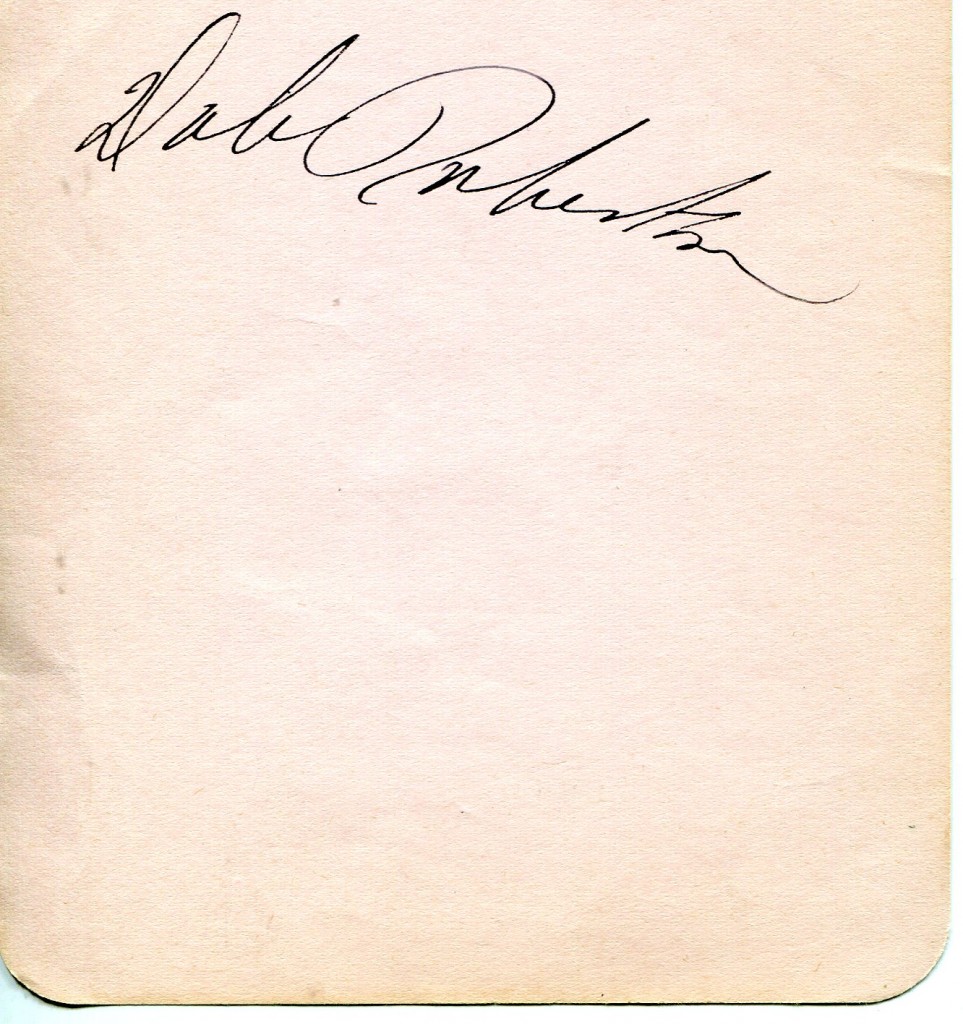
Dale Robertson
Dale Robertson
Robertson
 

Career overview of Dale Robertson

Dale Robertson (1923–2013) occupies a distinctive place in American screen history as a Western specialist who bridged the classical studio era and television’s dominance. Unlike many contemporaries who pursued range across genres, Robertson built a career defined by consistency, persona, and medium transition rather than transformation.


Early career: Fox contract player and reluctant actor (late 1940s–1950s)

Robertson’s entry into Hollywood was atypical. A decorated World War II veteran, he was reportedly discovered through photographs rather than formal training. He signed with 20th Century Fox and was developed as a leading man in the late 1940s.

Notable early films include:

  • Fighting Man of the Plains
  • The Silver Whip

He also appeared in non-Westerns like:

  • Gentleman’s Agreement (minor role)

Critical observation:
Robertson lacked the classical theatrical training associated with prestige actors, but this became an asset. His performances convey a naturalistic ease and understated masculinity, contrasting with the more stylized acting of earlier Western stars. However, even early on, the studio positioned him within a narrow genre corridor, limiting broader development.


Establishing a Western persona (1950s)

Throughout the 1950s, Robertson became increasingly associated with Westerns, including:

  • Sitting Bull
  • Dakota Incident

Critical analysis of persona:

  • His screen image is defined by quiet integrity rather than dominance
  • He often plays reluctant heroes rather than aggressive protagonists
  • Compared to someone like John Wayne, Robertson’s masculinity is less mythic and more approachable

Limitation:
While effective, this persona is not highly differentiated across films, leading to a sense of interchangeability. He becomes a type rather than a transformative actor.


Television stardom: peak visibility (late 1950s–1960s)

Robertson’s greatest success came with television Westerns:

  • Tales of Wells Fargo (1957–1962)
  • Iron Horse (1966–1968)

These shows made him a household name in the United States.

Critical observation:
Television suited Robertson’s strengths:

  • Episodic storytelling rewarded consistency over range
  • His understated style translated well to the smaller screen
  • He projected reliability and moral clarity, key traits for TV heroes of the era

Industrial context:
His move to television reflects a broader shift as film actors migrated to TV during the decline of the studio system. Unlike some who saw this as a downgrade, Robertson thrived, suggesting his appeal was rooted more in persona than cinematic scale.


Later career: genre persistence and gradual withdrawal (1970s–1990s)

Robertson continued working in Western-themed or adjacent roles, including:

  • Dynasty (recurring role)
  • Dallas (guest appearance)

His final film appearance was in:

  • J.W. Coop

Critical observation:
By this stage, Robertson’s career reflects genre persistence rather than reinvention. As Westerns declined in mainstream popularity, his visibility diminished. Unlike actors who transitioned into character roles across genres, he remained closely tied to a fading form.


Critical analysis of his work and legacy

1. The power—and limits—of persona acting

Robertson exemplifies persona-driven acting:

  • He brings a consistent identity to roles
  • Audiences know what to expect

Strength:
This creates trust and continuity, especially valuable in television.

Limitation:
It restricts artistic range; Robertson rarely disappears into roles in the way more transformative actors do.


2. Naturalism vs. mythic Western acting

Compared to earlier Western icons:

  • John Wayne → mythic, larger-than-life
  • Gary Cooper → moral gravitas

Robertson offers:

  • Everyman realism
  • Less rhetorical, more conversational delivery

Critical insight:
This anticipates later Western revisionism, but his material often does not fully exploit this subtlety, leaving his performances under-contextualised.


3. Television as an ideal medium

Robertson’s career suggests that some actors are:

Better aligned with television’s structural demands than cinema’s.

His strengths—consistency, likability, clarity—fit episodic storytelling, where:

  • Character evolution is incremental
  • Audience familiarity is key

In this sense, his career is a success story of medium adaptation, even if it limited cinematic prestige.


4. Lack of defining cinematic work

A central issue in evaluating Robertson is the absence of a canonical film performance:

  • No equivalent to a genre-redefining Western
  • No collaboration with major auteurs

This weakens his standing in film history despite his popularity.


5. Historical positioning: the “professional Westerner”

Robertson represents a category often overlooked in criticism:

  • Actors who sustain a genre industrially
  • Without redefining it artistically

He is essential to the maintenance of the Western as a mass entertainment form, even if not to its evolution.


Overall evaluation

Strengths:

  • Strong, consistent screen presence
  • Effective naturalistic acting style
  • Major success in television Westerns

Limitations:

  • Narrow genre range
  • Limited artistic transformation
  • Lack of landmark film roles

Conclusion

Dale Robertson’s career is best understood not through the lens of stardom or artistic innovation, but through industrial function and medium alignment. He was:

  • A reliable leading man in mid-century Westerns
  • A highly effective television star
  • A performer whose strengths lay in stability rather than reinvention

His legacy illustrates how Hollywood depended not only on iconic stars but also on durable professionals who embodied and sustained its most popular genres

Leave a Reply

Your email address will not be published. Required fields are marked *