Brittish Actors

Collection of Classic Brittish Actors

Simon Dutton
Simon Dutton
Simon Dutton

Simon Dutton was born in 1958 in Buckinghamshire.   He made his debut in 1981 in the TV series “Strangers”.   He went on to make “Harry’s Game”, “The Professionals”, “To the Lighthouse” and featured as ‘Simon Templer’ in a series of “The Saint”.

IMDB entry:

Simon Dutton was born in 1958 in Buckinghamshire, England. He is an actor, known forDangerous Beauty (1998), The Saint: Wrong Number (1989) and The Saint: The Brazilian Connection (1989). He has been married to Tamsin Olivier since June 1995. They have one child.   Educated at Central School of Speech and Drama – one of the most prestigious in the UK. Was married to the American actress Betsy Brantley. Second wife is actress Tamsin Olivier. Loves travelling. Often takes part in numerous charitable events and fund-raisers.   Is one of the Vice Presidents of The Saint Club along with the other actors who have portrayed the famous character.   Son-in-law of Laurence Olivier and Joan Plowright.   Brother-in-law of Richard Olivier and Julie Kate Olivier.   Attended Sir William Borlase’s Grammar School, a 17th century school located in Marlow, Buckinghamshire, England.   Not only played the Saint, Simon Templar, but was named after him, too. His mother was a keen Leslie Charteris reader.

The above IMDB entry can also be accessed online here.
Kathleen O’Regan
Kathleen O'Regan
Kathleen O’Regan

Kathleen O’Regan was born in 1903 in Dublin.  In 1929 she starred as ‘Mary Boyle’ in Alfred Hitchcock’s “Juno and the Paycock”.   She also starred in “The Shadow Between” and “The Rose of Tralee”.

!The Times” obituary from 1970:

Miss Kathleen O’Regan, the actress, who died on Thursday, will be remember for her performances in the first London productions of Sean O’Casey‘s Juno and the Paycock and The Plough and the Stars. In the first she played the daughter; of the two characters from whom the tragedy takes its title, and in the second she played, in succession to Eileen Carey, the young wife who is driven out of her wits by the events of Easter Week, 1916.

Later productions that gave scope to her sense of character or feeling for comedy were those of Van Druten’s Young Woodley, in which she played opposite Frank Lawton when it was first tried out by Basil Dean in England; of By Candle Light, an adaptation from the German (“Never choose wine or women by candle light”), in which she succeeded Yvonne Arnaud as a lady’s maid masquerading as her employer; and of Banana Ridge, which Ben Travers fashioned to suit Alfred Drayton and Robertson Hare, respectively the lion and the mouse of contemporary farce, and in which Travers himself suggested her for the lion Drayton’s mate.

She began her film career by playing her old part under Alfred Hitchcock in Juno and the Paycock, which is credited with being the first British film to have been planned and made from its earliest stages as a “talkie”.

Kathleen O’Regan was married to Lieutenant-Colonel K. A. Plimpton, D.S.O., who was for fourteen years Secretary of the Garrick Club.

Jimi Mistry
Jimi Mistry

Jimi Mistry was born in Scarborough, Yorkshire in 1973 of an Indian father and an Irish mother.   His movies include “East Is East”, “The Guru” and “Blood Diamond”.

“Entertainment.ie” article:

We still remember him well as that young fella from East is East (look it up, it’s brilliant) but now we’re getting used to the sight of Jimmy Mistry on the Coronation Street cobbles. The actor joined the cast as personal trainer and friend of Gary’s Khalid just last weekend and revealed that he had no qualms about jumping from the big screen to soap land.

“Not really” Mistry replied when Lorraine Kelly asked if the transition had been a difficult one to make. “I have to be honest with you, because it’s about the opportunity” he said. “I’ve done loads of things, a lot of travelling around the world doing this, that and the other.”

“I met with Stuart [Blackburn] the producer and there was an opportunity to join the show. Corrie has been a big favourite of mine over the years. It gave me a great opportunity and the great thing about doing something like this is that the writing is so fantastic.

“As an actor, you get to work every day. It’s a very rare thing for an actor and it’s a gift to be given, to go into a show like Corrie. It wasn’t really a tough decision for me.”

Ah Jimmy, sure won’t your Guru always have a special place in our hearts?

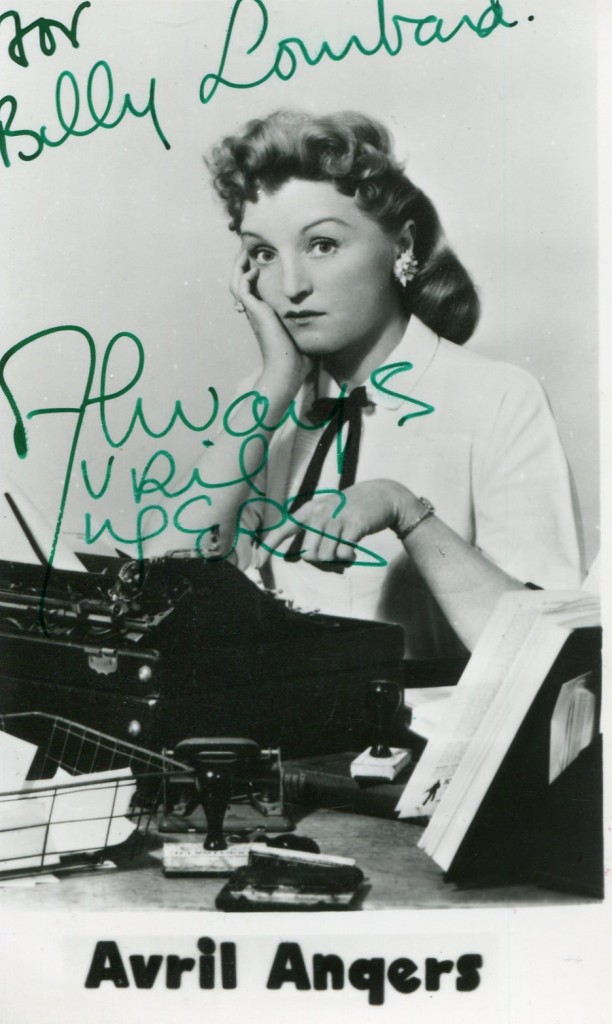
Avril Angers
Avril Angers
Avril Angers

Avril Angers was born in 1918 in Liverpool.   She was a major character actress in films of the 1950’s and 60’s.      One of her major movies was “The Family Way” in 1966.   She died in 2005.

Dennis Barker’s obituary in “The Guardian”:

Avril Angers, who has died aged 87, was a comedian, actor, singer and star of radio, theatre – and pantomime. On television she had a career that spanned six decades, beginning in the postwar period with Terry-Thomas, taking in such shows as Coronation Street and Dad’s Army along the way, and ending in the 1990s with Common As Muck and All Creatures Great and Small. A onetime Tiller Girl, Angers had a particular talent for playing beguiling but slightly wacky heroines and she could switch from below-stairs earthiness to instant glamour with ease.

Born in Liverpool, the daughter of the Liverpool comedian Harry Angers and of Lilian Errol, one of the original Fol de Rols concert party, Angers went to various schools in England and Australia, and first appeared on the boards in 1936 in the chorus of a show on Palace Pier, Brighton. That same year she made her first big impression when she appeared at the Alexandra Theatre, Birmingham, with the tiny comedian Wee Georgie Wood and the great Dame, Clarkson Rose, in the title role of Cinderella.

Unlike the usual “magic” puff-of-smoke transformation of Cinderella when she goes to the ball, this production had her dressed in full view of the audience by two fairies. The run had hardly begun when one of the fairies failed to appear. The other whispered to Angers that she was searching backstage for Cinderella’s second slipper, which was lost. In the end Angers had to admit defeat and go on acting the part of the newly radiant heroine hobbling about in only one slipper while backstage the two fairies were coming to blows.

Angers was to find that happening a template for much of her life, which included unusual incidents like the time she put £75 worth of fivers into an envelope and sent it off to a radio producer instead of returning a script. Afterwards she was convinced she had been robbed. Only a bewildered telephone call from the producer gave her back her composure.

When war came, she appeared in Fol de Rols and then joined the armed forces entertainment organisation Ensa. She spent two years in the Middle East and West Africa and was awarded the Africa Star. In Cairo, she was spotted by the BBC producer Douglas Moodie, who suggested that she should get in touch. She made her first radio appearance in May 1944. It was that year too that she made her west end stage debut in the review Keep Going, at the Palace. This was followed in 1945 by The Gaieties, alongside Leslie Henson and Hermione Baddeley, at the Winter Gardens.

Back on radio she made a vivid impact as the talent spotter Carroll Leviss’s unpredictable secretary in his regular series. Her radio career at one stage embraced five shows at once: Bandbox, Navy Mixture, Merry Go Round, Wishing You Well Again and Monday Night At Eight.

She claimed she was “almost forced” into television not long after the BBC’s service resumed after the war. She was appearing in the Make It a Date revue at the Duchess Theatre with comedian Max Wall, when a very determined producer asked her to appear on the small screen. There had been attempts to get the whole revue on to television, but the impresarios, seeing TV as a threat, refused. Angers decided to go it alone, and between 1946 and 1948 appeared regularly in Stars in Your Eyes.

Another of the television series that made her after the war was as Rosie Lee in How Do You View, from 1949, with Terry-Thomas as a boss always being bothered at unsuitable moments by the tea girl wanting to know how he wanted his tea, while at the end of every show he enjoyed an imaginative interlude with a glamour girl of his dreams. Both tea girl and beauty were played by Angers.

At the beginning of the 1950s, she deliberately made regular guest appearances with repertory companies, where the money was less but the opportunities for broadening her range better. She appeared in plays varying from Congreve’s Love for Love (1949) to Garson Kanin’s Born Yesterday (1950).

In the 1950s her stage work took her around the country and by 1960 she was starring at the Lyric Hammersmith in an American comedy The Nightlife of a Virile Potato. She spent 1962 in Australia in the revue Paris By Night. Back in London in 1964 she played the central role with Bruce Forsyth in the musical Little Me and used her singing voice to good effect. Later she featured in The Mating Game, Cockie – back with Max Wall – and No Sex, Please, We’re British. By 1976 she was playing Miss Marple in Agatha Christie’s Murder At the Vicarage. In the 1980s she appeared at the King’s Head in Islington in two Noel Coward plays, Post-Mortem and Easy Virtue.

Her first film was The Lucky Mascot (1948, also known as The Brass Monkey). Told by actors and friends after shooting had ended that she was so good in it that she should stand by for further film offers, she declined stage offers and waited for the big film career to arrive. It never really did but her next opportunity came with the comedian Hal Monty in Skimpy in the Navy (1950). This was followed in the same year by Miss Pilgrim’s Progress, and in 1954 by Don’t Blame the Stork. In 1956 she appeared in four films, Women Without Men, The Green Man, Bond of Fear, and Blonde Bait. In 1957 came Light Fingers.

On television, in 1954 she starred in two BBC sitcoms: one, Dear Dotty, set on a women’s magazine and the other, Friends and Neighbours, focusing on two pairs of newlyweds. Two years later, she switched to the new ITV opposite Sam Costa in the sketch series The Charlie Farnsbarns Show. With the birth of Coronation Street in 1960 she featured as Norah Dawson.

By the time she was appearing in Common As Muck (1994), Roy Hudd had called her “a wonderful professional”. It was a television comedy series with moments of dramatic depth about a group of dustbinmen facing privatisation.

In 1949 she announced her engagement to the actor Barry Wickes, only to declare, nearly two years later, while in a summer show at Bexhill-on-Sea, that she was “too busy” for marriage. She is survived by two brothers.

· Avril Florence Angers, comedian, actor and singer, born April 18 1918; died November 8 2005

The above “Guardian” obituary can also be accessed online here.

Josef Locke
Josef Locke
Josef Locke

Josef Locke was born in 1917 in Derry.   A famous singer in Britain during the 1940’s, his songs include “Goodbye” from “The White Horse Inn” and “Here My Song, Violetta”.   He appeared in a few movies including “What A Carry On” in 1939.   He died in 1999.

Stephen Dixon’s obituary in “The Guardian”:
“Goodbye, goodbye – I wish you all a fond goodbye.” As he strutted the stage, his glorious tenor soaring to the back of the “gods” in the north of England’s variety theatres, Josef Locke’s tearful and adoring audiences sang along and waved their handkerchiefs in time to the music. Locke, who has died aged 82, was an Irish superstar, the Tom Jones of his day – earning £2,000 a week when £100 was a good wage for a music-hall artist.

His voice could have taken him to the world’s great opera stages, but he chose the more raffish life of a variety bill-topper, specialising in sentimental ballads such as Hear My Song, Count Your Blessings and I’ll Take You Home Again, Cathleen, invariably closing his act with stirring audience galvanisers like Blaze Away or Goodbye. He was handsome, immaculately tailored and flamboyantly rogueish, with a trim moustache and a twinkling eye for the ladies.

Locke based himself in Blackpool, also home to his good friend, the comedian Frank Randle. Together they caroused, brawled and drank through the night, got up to various romantic escapades and lost fortunes on the horses. It was, in fact, Locke’s offstage antics that created the legend around him – he happily squandered his vast earnings, and in 1958 fled back to Ireland with the Inland Revenue hot on his heels. The day a warrant for his arrest for unpaid taxes was issued in Blackpool, he was in Kildare, paying 790 guineas for two horses. He named one of them The Taxman.

The story was told, charmingly but fancifully, in Peter Chelsom’s 1992 film Hear My Song, in which Locke was played by Ned Beatty. For the premiere, the 75-year-old singer was persuaded to return to England, where he sang Danny Boy to Princess Diana. When Chelsom first mooted the project to Locke, he found the singer only too willing to add to his legend – at one point the director had to track him down to a bar in Spain after he disappeared without signing the contract for clearance rights.

Josef Locke was born Joseph McLaughlin in Derry, Northern Ireland, the son of a butcher and cattle dealer, one of 10 children. He sang at churches in the Bogside as a child, and after a rudimentary schooling joined the Irish Guards, later serving with the Palestine police before returning to Ireland in the late 1930s. He then became a policeman and, performing semi-professionally, was known as “the Singing Bobby”. He sought advice about an operatic career from the greatest Irish tenor of them all, John McCormack, who told him that his natural showmanship might serve him better on the popular stage. Again on the advice of McCormack, Locke went to London to see impresario and bandleader Jack Hylton, who, impressed, booked him into the Victoria Palace. It was Hylton who renamed him – Joseph McLaughlin was considered too long for variety bills.

After some success in London, where he made his first recordings in 1947, Locke signed with Lew and Leslie Grade, who realised that his over-the-top style and penchant for sentimentality might go down better on the northern variety circuit, and steered him to stardom. Locke delighted in the world of variety, revelling in his celebrity, wearing only the best clothes and driving the fastest sports cars, always accompanied by a glamorous companion.

He also appeared in films for John E Blakeley’s Manchester-based Mancunian company, starring with other music-hall stalwarts like Randle, Tessie O’Shea and Jewel and Warriss. Some critics were sniffy about what they saw as the misuse of a fine voice. “The Londonderry tenor did indeed possess a fine organ,” wrote one, “ruined by undisciplined bawling and a delivery drenched in sentimentality.”

However, Locke’s (mainly female) public thought otherwise, and there was no sign of a diminution in his popularity when he suddenly vanished back to Ireland. Twenty years later, a masked singer, sounding uncannily like Locke and billed as “Mr X”, made some appearances in British clubs, and it was thought that he had returned incognito. It turned out not to be the case, although on one occasion he was flown into Britain to appear on This Is Your Life – and then flown straight out again before the taxman could catch him.

The success of the film Hear My Song – Chelsom used the “Mr X” story as the basis for his heart-warming fantasy – brought Locke back into the limelight, and an album of his old recordings became a bestseller. The tax business now long-forgiven, he continued to sing, mostly in Ireland, until fairly recently, then retired. He lived the latter part of his life near Clane, Co Kildare, and is survived by his wife, Carmel, and a son.

• Josef Locke (Joseph McLaughlin), singer, born March 23 1917; died October 15 1999

The above “Guardian” obituary can also be accessed online here.

Dictionary of irish biography

Locke, Josef (1917–99), singer and entertainer, was born Joseph McLaughlin 23 March 1917 at 19 Creggan St., Derry city, one of ten children of Patrick McLaughlin, butcher and cattle dealer, and Annie McLaughlin (née Doherty). Educated by the Christian Brothers and awarded for his singing at local feiseanna, he performed at St Eugene’s cathedral. Family business difficulties forced him to leave school at 14 and take casual jobs till enlisting underage (16) in the Irish Guards. Serving in Egypt, McLaughlin was the regiment’s youngest sergeant at 18. He sang with the regimental band, whose BBC concerts were his earliest broadcasts. His vocal range was extraordinary and he continued singing throughout his short police career, initially in the Palestine police and latterly in the RUC, which he joined in 1938 on his return to Northern Ireland. ‘The singing bobby’ grew disillusioned with policing and availed himself of opportunities to advance his growing celebrity, including voice instruction in Italy.

As the second world war restricted foreign travel he successfully auditioned in Belfast about 1941 for the visiting Dublin entertainer and producer Jimmy O’Dea (qv). He played Gaylord in ‘Showboat’ at the Gaiety Theatre and sang at the Theatre Royal, both Dublin venues owned by Louis (qv) and Max Elliman (qv). The wartime absence of foreign artists placed Irish names in higher demand, but McLaughlin’s income remained less than he was prepared to accept. Similarly, O’Dea’s fit-up theatre circuit of rural Ireland in the early 1940s, alternating between performance and menial drudgery in unsatisfactory venues, frustrated his desire for stardom. McLaughlin’s critically acclaimed work for the Dublin Grand Opera Society, first as Pinkerton in Puccini’s ‘Madama Butterfly’ and as Enzo Grimaldi in Ponchielli’s ‘La Gioconda’ at the Gaiety, encouraged his ambition. Advised by tenor Count John McCormack (qv) who was little impressed with his outings in grand opera, McLaughlin moved to a war-weary London in 1945. Beginning at the Victoria Palace, he established himself in variety with the legendary Jack Hylton and his band, but deliberately extended his repertoire to include religious and popular operatic selections, rousing anthems for which his clear, piercing voice was suited. Further advised, reputedly by Hylton, to shorten his name for billboard display, Joseph McLaughlin became ‘Josef Locke’ from about this time.

For a new star he had phenomenal popular appeal, unquestionably the product of his powerful voice and passionate delivery but also of his magnetic stage presence and physical energy. His deep eyes and military bearing, complete with turned moustache, gave him the appearance of a large and likeable rogue, which remained with him for life. His Derry accent was audible in performance as he earned fame and fortune in England, particularly the north, in the late 1940s. Nor did he abandon his roots in other ways, including his ‘Irish’ repertoire, which typically featured ‘Galway Bay’ and ‘I’ll take you home again, Kathleen’.

Locke easily blended into his new surroundings. From 1946 he began a long annual engagement in Blackpool’s Opera House holiday shows, living locally as proprietor of a garage and public house on the proceeds of his lucrative career. In 1947 he started in pantomime in Liverpool and toured Australia with Blackpool co-star George Formby. He had recently begun recording his lifelong standards, notably ‘The holy city’ and ‘Hear my song, Violetta’, which became one of his signature numbers (anglicised by Harry S. Pepper from a German original), generally known as ‘Hear my song’ with a tango rhythm both attractive and infuriatingly difficult to dispel. Similarly, ‘Goodbye’ and his most dramatic standard, ‘Blaze away’, remained in the ears of audiences long after the singer had left the stage. Few artists outside grand opera could claim such an entrancing effect on listeners, and Josef Locke compensated for his merely ‘popular’ status with an income whose size both surprised and drew the hostile attention of the Inland Revenue. His agents Leslie and Lew Grade, who had conducted him through his British career, later assisted in regularising his chaotic tax situation.

Locke’s first broadcast since the Irish Guards’ BBC concerts was on radio in 1949 in ‘The Happydrome’. Other engagements included television, then in its infancy. He appeared on screen in ‘Rooftop rendezvous’, in ‘Top of the town’, and in the Frankie Howerd show. Within a decade Locke was a star of every medium. His brief film career at the turn of the 1950s (Holidays with paySomewhere in politics, and What a carry on) was inauspicious but for his opportunity to earn lasting fame for the songs he included. Allegedly for being excluded from a special Royal Variety Performance held in Blackpool in 1955 (he had already played the London Palladium), he sold up and relocated to the US. Unhappy in America, Locke returned to Blackpool. By 1958 the UK revenue inspectors clearly suspected tax evasion, complicated by the inexact science of gambling on horses. Locke worked undaunted till tax notices turned into an arrest warrant. Going to ground, he eventually reappeared in Ireland as a farmer, publican, and racehorse owner. From this safe distance he settled his British tax liabilities.

Settling in Clane, Co. Kildare, Locke sought to recreate an international career, taking in Dublin’s Olympia Theatre and other Irish venues. By 1970 he faced bankruptcy and was fined in the Dublin district court for removing company registration documents. Although his star faded, notwithstanding musical engagements and occasional record releases, a special 1984 RTÉtelevision tribute on Gay Byrne’s ‘Late late show’ restored some of its lustre. In 1992 the unexpected success of Peter Chelsom’s semi-biographical fantasy film Hear my song, starring Ned Beatty as Josef Locke, revived his career to include a place in Britain’s top ten pop listing. Attending the film’s London premiere, Locke famously received an ITV ‘This is your life’ tribute. Genuinely amazed at his renewed popularity, Josef Locke lived out his remaining seven years in Clane with his fourth wife, Carmel Dignam. By his previous marriages he had had six children. He died at a Clane nursing home 15 October 1999 and was cremated at Glasnevin cemetery. In 2005 a bronze memorial bust, designed by Terry Quigley and sculpted by Maurice Harron, was unveiled in Derry.

Sources

Philip B. Ryan, Jimmy O’Dea, the pride of the Coombe (1990), 94, 96, 186; Philip B. Ryan, Noel Purcell: a biography (1992); Colin Larkin (ed.), Guinness dictionary of popular music (2nd ed., 1995), vi, 2530–31; Gus Smith, Irish stars of the opera (1994); Kevin Rockett (ed.), The Irish filmography; fiction films 1896–1996 (1996); Ir. Times, Daily TelegraphIndependent (London), 16 Oct. 1999; Sunday Independent, 17 Oct. 1999; ODNB; information from Harbour Museum, Derry