

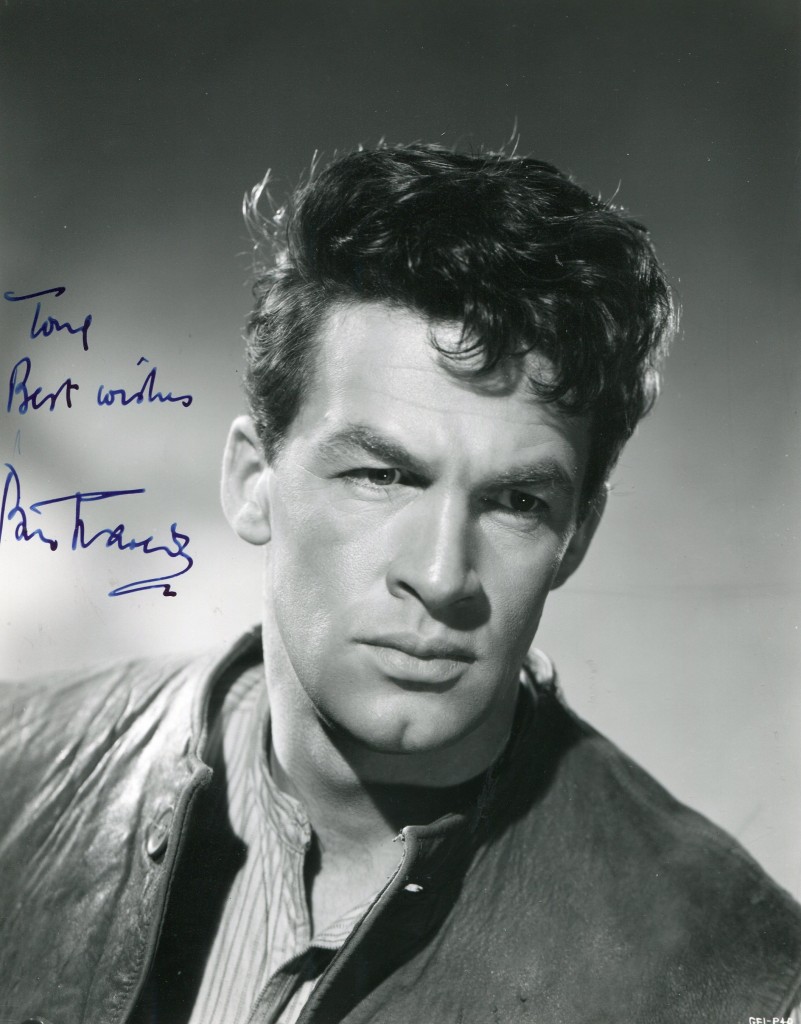


BILL TRAVERS OBITUARY IN “THE INDEPENDENT” BY DAVID SHIPMAN IN 1994.
Bill Travers was a British actor and well-known animal rights activist. He was born in Newcastle-on-Tyne in 1922. He began making films in the early 1950’s gaining larger parts by the middle of the decade. He went to Hollywood where me made films witch such actresses as Eleanor Parker, Ava Gardner and Jennifer Jones. Long married to Virginia McKenna, they made several films together including “Born Free” . Bill Travers died in 1994.
Bill Travers features extensively in his wife Virginia McKenna’s book “The Life in my Years”.Independent obituary by David Shipman:
BILL TRAVERS was an actor of rugged good looks and a cheery personality at a time when the British film industry was not much interested in creating or maintaining stars. Like such contemporaries as Michael Rennie and Richard Todd he was wooed by the Hollywood studios, but he is best remembered for his British movies.
The younger brother of Linden Travers, the charming vamp of the Thirties and Forties, he had much experience in the theatre before making his film debut, in Conspirator (1949). He was first noticed as one of the PoWs in The Wooden Horse (1950) and then as the teacher keen on cricket in Anthony Asquith’s film of Terence Rattigan’s play The Browning Version (1951). After a number of other supporting roles he played Benvolio in a film which has seemingly gone missing – Romeo and Juliet (1954), gorgeously filmed on locations in Verona by Renato Castellani, who persuaded the Rank Organisation to let him have an amateur Juliet, Susan Shentall, and an unconvincing Romeo, Laurence Harvey: but the director George Cukor liked Travers sufficiently to cast him in MGM’s ambitious Bhowani Junction (1956) – much to the actor’s satisfaction, as the author of the original novel, John Masters, had been his Brigade Major when he had served in the Chindits. Travers also felt that his six years in the East had given him an insight into the vulnerability of the Eurasian railway superintendent that he played – as well as teaching him the accent that the role needed. The stars were Stewart Granger and Ava Gardner.
Before the film was shown Travers was about to join Windsor rep when he was asked to test for Geordie (1955), the first venture of the writer-producer-director team of Frank Launder and Sidney Gilliat following the death of Alexander Korda. They had put their own money into the project, but had difficulty persuading the distributor, British Lion, to let them cast a virtual unknown in the title-role – that of a puny Highland lad who takes a correspondence course in physical education and ends up throwing the hammer for the British Olympic team at Melbourne. The critic Gavin Lambert wrote: ‘Bill Travers is a young player of individual gifts, and he conveys the shy, honest simplicity of Geordie most pleasingly; this is a performance attractively free of mannerism, and has a genuine freshness.’
The film was a great success, both in Britain and in the United States, overshadowing Travers’s stint as an earnest young lawyer in Footsteps In The Fog (1955), which starred Stewart Granger and his then wife, Jean Simmons, both being villainous. Granger was under contract to MGM, which did not find him entirely docile. That studio signed the more amenable Travers after liking his work in Bhowani Junction, and cast him as Robert Browning in the remake of The Barretts of Wimpole Street (1956), directed by Sidney Franklin, who had made the original screen version in 1934. John Gielgud offered a more convincing character study of Mr Barrett than Charles Laughton had done; and Jennifer Jones was suitably inhibited as Elizabeth.
Henrietta Barrett was played by Virginia McKenna, who became Mrs Travers in 1957. They received a splendid wedding present in William Rose’s script for The Smallest Show On Earth (1957), an affectionate and funny comedy about a young couple who inherit a flea-pit and keep it open against the competition of the supercinema round the corner. Their antique staff consisted of Margaret Rutherford, Peter Sellers and Bernard Miles, and they were all of them delightful in this Launder and Gilliat production directed by Basil Dearden.
Travers followed with a couple of flops. The Seventh Sin (1957)was MGM’s injudicious remake of Somerset Maugham’s story The Painted Veil, which had starred Garbo. Eleanor Parker was no substitute as the unfaithful wife and Travers could not make sense – nobody could have – out of the cuckolded husband. Passionate Summer (1958) was Rank’s retitling of Richard Mason’s best-seller The Shadow and The Peak. The film’s director, Rudolf Cartier, had achieved an eminence in television but proved ill at ease with a movie for the large screen; Travers plays a schoolteacher in Jamaica, and McKenna the air hostess with whom he is in love


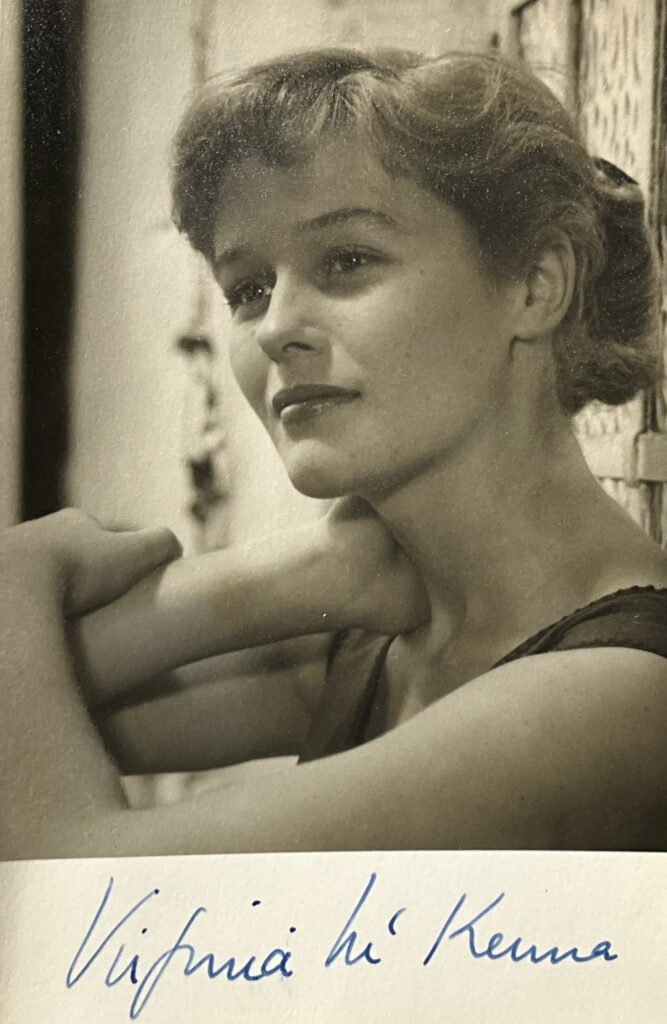
Career overview
Bill Travers (William Inglis Lindon Travers, 1922 – 1994) was a British actor, writer, director, and—ultimately—wildlife conservationist, best remembered for Born Free (1966), a role that not only defined his screen legacy but also transformed his life’s direction. His career traces a distinctive arc: from postwar British leading man to international advocate for animal welfare, symbolizing how cinema can intersect with moral and ecological purpose.
Early life and wartime service
Travers was born in Newcastle upon Tyne into a theatrical family: his father managed theatres, and his sister Linden Travers also became a film actress . During World War II, he served with distinction in the British Indian Army and the Gurkhas in Burma and Malaya, ending the war as a major in the Special Operations Executive .
His military discipline and self‑reliance would later shape his on‑screen characters—stoic, physically capable men with inner sensitivity.
Early acting career and breakthrough (1949–1955)
After demobilization, Travers turned to repertory theatre and early British television, entering films in minor roles before his breakout as the gentle Scottish hammer‑thrower in Wee Geordie (1955). The film’s combination of athletic comedy and heartland optimism made him a star at home and abroad . Travers’s screen persona merged physical stature—he stood 6′4″ —with emotional warmth, appealing to audiences weary of wartime cynicism.
Versatility and consolidation (mid‑1950s)
He followed with contrasting performances:
- The war epic The Seventh Sin (1957), showing understated dramatic weight.
- The light comedy The Smallest Show on Earth (1957), opposite his future wife Virginia McKenna, revealing deft comic timing.
- The Barretts of Wimpole Street (1957) and Storm over Jamaica (1958), where he refined a quality of moral earnestness anchored by easy authority.
These roles positioned Travers within a generation of post‑Ealing leading men, likable and clean‑cut but increasingly overshadowed by the emerging “angry young” realism of the late 1950s.
Born Free (1966): Stardom and transformation
Travers’s defining role came as George Adamson opposite McKenna’s Joy Adamson in Born Free, telling the real story of Elsa the lioness’s rehabilitation and release. The film was both a box‑office success and an emotional landmark—an example of ecological consciousness entering mainstream cinema .
Travers’s natural empathy with animals and unforced sincerity transformed what could have been sentimental material into something genuinely moving. The authenticity of the couple’s relationship—fictional and real—generated a palpable warmth that audiences worldwide recognized.
The experience also redirected his life. According to IMDb , participating in Born Free“lessened his interest in film acting and led to his increased involvement in wildlife conservation.”
From actor to activist (late 1960s–1980s)
Travers and McKenna channeled their professional momentum into conservationist cinema: An Elephant Called Slowly (1969) and Ring of Bright Water (1969) again linked human empathy to animal welfare. They later co‑founded the Born Free Foundation in 1984, combining advocacy, filmmaking, and education . Travers also wrote and directed documentaries about captive animals, using his film celebrity to raise awareness about zoo conditions and animal trade practices.
Acting style and screen persona
- Physical grace and warmth: Travers’s imposing height gave him presence, but his acting was marked by gentleness rather than dominance.
- Moral authenticity: His characters typically embodied decency and self‑sufficiency, qualities resonating with postwar British ideals.
- Restraint and truthfulness: Avoiding melodrama, he communicated emotion through understatement—a style that aligned with the British tradition of quiet heroism.
- Naturalism in human–animal interaction: Especially in Born Free, his rapport with wildlife projected real compassion; this authenticity became inseparable from his off‑screen activism.
Later life, directing, and legacy
In later years he acted less, directing the feature The Lion at World’s End and later producing animal‑rights documentaries. His advocacy culminated in An Elephant Called Slowly and in the establishment of the Born Free Foundation, which still operates globally today.
Travers died in Surrey in 1994, but his cultural impact endures through conservation as much as cinema. Historians such as Robert Sharp in the Oxford Dictionary of National Biography emphasize that his later activism “made his life a fusion of art and ethical commitment” .
Critical assessment
Strengths
- A rare blend of commanding physicality and emotional empathy.
- Unaffected naturalism that made “ordinary virtue” cinematic.
- Ability to link entertainment with ethical seriousness.
Limitations
- His deliberate simplicity sometimes read as stiffness; critics occasionally found his performances lacking dramatic volatility.
- Leaving mainstream acting early curtailed what might have become a more varied later career.
Legacy
Bill Travers remains emblematic of mid‑century British cinema’s humane strain—actors who balanced morality with accessibility. Yet he transcended film celebrity by converting screen mythology into real‑world advocacy. From Wee Geordie to Born Free, his life charts a coherent evolution: performance as empathy, art serving conscience. His name today resonates not merely in film history but in the continuing work of the Born Free Foundation—a testament to how one actor’s compassion reshaped both culture and conservation ( )