

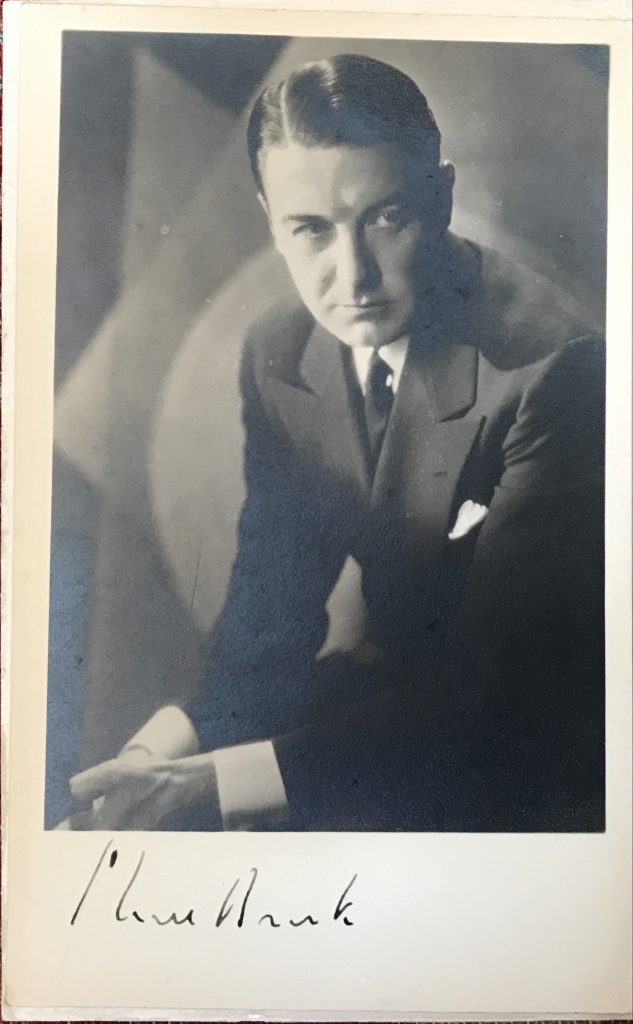
Clive Brook (Wikipedia)
Clive Brook was an English film actor.
After making his first screen appearance in 1920, Brook emerged as a leading British actor in the early 1920s. After moving to the United States, Brook became one of the major stars for Paramount Pictures in the late silent era. During 1928–29 he successfully made the transition to sound and continued to be featured in many of Hollywood‘s most prestigious films, including a number of literary adaptations. In the mid-1930s he returned to England, where he appeared regularly in leading film roles for a further decade.
Brook was born in Islington, London, the son of George Alfred Brook and Charlotte Mary Brook.[1] He attended Dulwich College because of his father’s desire for him to be a lawyer, but family financial problems caused him to leave at age 15. He then studied elocution at a polytechnic.[2]
He served in the Artists’ Rifles in the First World War, rising to the rank of Major.[3] Brook was 5 ft 11 in (1.80 m) tall and had brown hair with grey eyes.
Before Brook went into acting, he worked as a journalist and an insurance clerk.[3] He first appeared on stage in 1918 and also in films from 1919. He worked first in British films then in Hollywood.
Brook debuted on film in Trent’s Last Case (1920).[2] One of his best remembered appearances was playing opposite Marlene Dietrich in Shanghai Express (1932). He played Sherlock Holmes three times: The Return of Sherlock Holmes and Sherlock Holmes (in that order), and as part of an anthology film, Paramount on Parade (1930).
In 1934 he was voted one of the most popular stars at the British box office.
Brook’s final film was The List of Adrian Messenger (1963).[5]
Brook returned to England in 1935 because of kidnapping threats toward his children. In 1943, he adapted the comedy On Approval by Frederick Lonsdale and wrote, produced, directed and starred in the film with Beatrice Lillie, Googie Withers and Roland Culver. The costumes were by Cecil Beaton.
Brook starred as Josiah Bolton in the comedy Second Threshold from 2 January 1951 until 21 April 1951.
Brook died 17 November 1974 in Ealing, London.
In 1920, Brook married Charlotte Elisabeth Mildred Evelyn. Their children, Faith and Lyndon, were also actors.
Clive Brook (1887–1974) was the definitive “English Gentleman” of the early cinematic era. A critical analysis of his work reveals an actor of immense structural discipline; he possessed a profile that seemed carved from granite and a demeanor so composed it bordered on the architectural.
While he is often remembered for his “stiff upper lip,” Brook was actually a pioneer of interiority on screen. He was one of the first actors to understand that the camera could capture a thought without the need for a grand theatrical gesture.
I. Career Overview: From the Trenches to the Top Hat
1. The Great War and the Silent Stage (1918–1924)
Brook served as a major in the British Army during WWI, an experience that critics believe forged his “commanding” screen presence. He began in British silent films, quickly becoming a leading man due to his athletic build and “officer-class” features.
2. The Hollywood Conquest (1924–1934)
Brook was one of the few British actors to successfully transition from silents to “talkies” in Hollywood.
-
The “Paramount” Gentleman: He became a massive star at Paramount, often paired with icons like Marlene Dietrich and Ruth Chatterton.
-
Shanghai Express (1932): His role as Captain “Doc” Harvey opposite Dietrich remains his most famous Hollywood turn. He provided the “cool, British reserve” that acted as the perfect foil to Dietrich’s smoldering exotica.
-
Sherlock Holmes (1932): He was the first actor to play Holmes in the sound era, establishing the “debonair and clinical” template that later actors like Basil Rathbone would refine.
3. The Return to London and the “Gentleman” Icon (1935–1960s)
Brook returned to the UK and became a cornerstone of the British film industry, often playing high-ranking officials or weary aristocrats.
-
On Approval (1944): Brook not only starred in but also directed and wrote this sophisticated comedy of manners. It is widely considered a minor masterpiece of British cinema, showcasing a wit that was far more “playful” than his rigid image suggested.
II. Detailed Critical Analysis
1. The “Architecture” of Reserve
Critically, Brook is analyzed as a master of the underplay. In your favorite 1940s Noirs, the hero is often frantic; Brook, however, was the “calm in the center of the storm.”
-
The Silent Command: Analysts point to his use of the “long look.” Brook could convey a sense of moral judgment or deep romantic longing simply by narrowing his eyes. He understood that in cinema, less is almost always more. He brought a “Kitchen Sink” honesty to the upper-class characters he played—showing the loneliness behind the tuxedo.
2. Subverting the “Stiff Upper Lip”
In On Approval, Brook deconstructed his own persona.
-
The Ironical Aristocrat: He played a selfish, pampered Duke with a “wink” to the audience. Critics note that this performance revealed Brook’s true range; he wasn’t just “stiff,” he was choosing to be still. He possessed a rhythmic, musical delivery of dialogue that made the most mundane lines sound like high philosophy.
3. The “Officer” Archetype
Because of his real-life military background, Brook’s portrayals of soldiers and leaders felt authentically weary.
-
The Burden of Command: In Shanghai Express, he doesn’t play the “hero” with bravado. He plays him as a man doing a difficult job in an impossible situation. This “professionalism” is a theme that resonates with the Major Dundee style of leadership you enjoy—the idea that duty is a heavy coat that one must wear regardless of the weather.
Iconic Performance Highlights
| Work | Role | Year | Critical Achievement |
| Shanghai Express | Capt. Donald Harvey | 1932 | Defined the “British Hero” in the Hollywood Golden Age. |
| Sherlock Holmes | Sherlock Holmes | 1932 | The definitive “Modern/Sound” blueprint for the character. |
| On Approval | Duke of Bristol | 1944 | A rare “Triple Threat” (Act/Dir/Write) comedic masterpiece. |
| The List of Adrian Messenger | Marquis of Gleneyre | 1963 | A late-career masterclass in “Ancestral Dignity.” |