

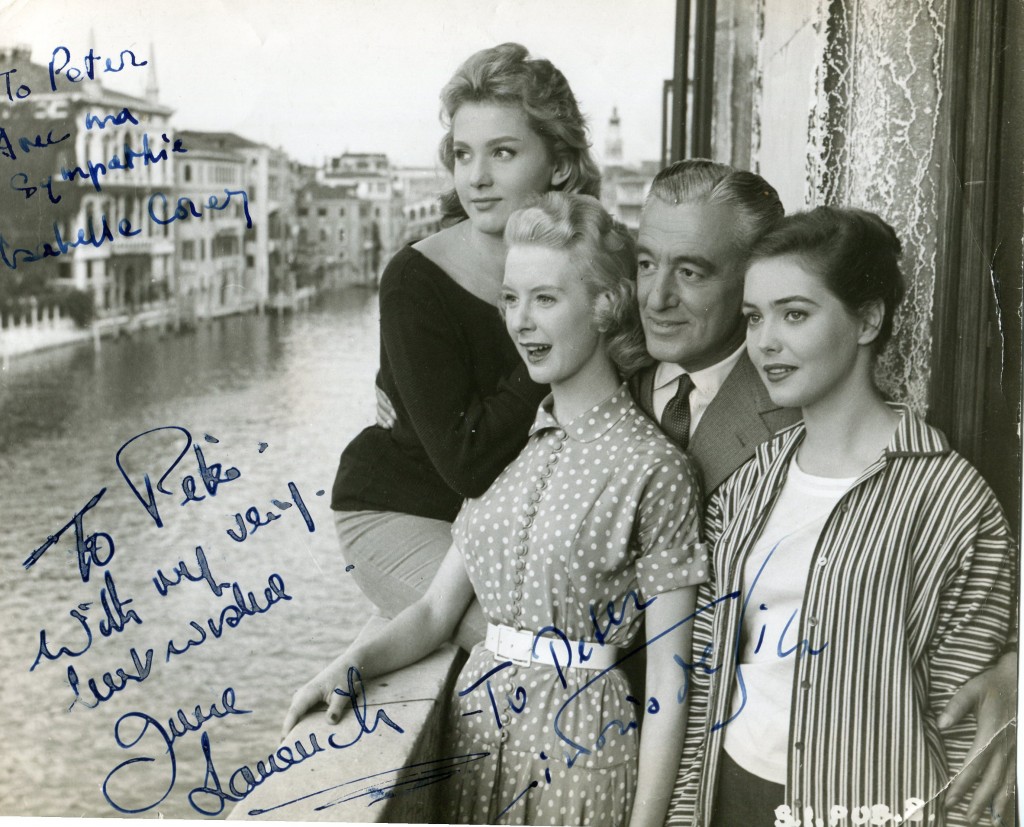
Vittorio de Sica

Vittorio de Sica, Isabelle Corey & June Laverick

TCM Overview:

Italian director Vittorio De Sica was also a notable actor who appeared in over 100 films, to which he brought the same charm and brightness which infused his work behind the camera.

By 1918, at the age of 16, De Sica had already begun to dabble in stage work and in 1923 he joined Tatiana Pavlova’s theater company. His good looks and breezy manner made him an overnight matinee idol in Italy with the release of his first sound picture, “La Vecchia Signora” (1931). De Sica turned to directing during WWII, with his first efforts typical of the light entertainments of the time. It was with “The Children are Watching Us” (1942) that he began to use non-professional actors and socially conscious subject matter. The film was also his first of many collaborations with scenarist Cesare Zavattini, a combination which shaped the postwar Italian Neorealist movement.

With the end of the war, De Sica’s films began to express the personal as well as collective struggle to deal with the social problems of post-Mussolini Italy. “Shoeshine” (1946), “The Bicycle Thief” (1948) and “Umberto D” (1952) combined classic neorealist traits–working-class settings, anti-authoritarianism, emotional sincerity–with technical and compositional sophistication and touches of poignant humor.

De Sica continued his career as an actor with sufficient success to finance some of his directorial projects, playing a host of twinkling-eyed fathers and Chaplinesque figures in films such as “Pane, amore e gelosia” (1954). His later directorial career was highlighted by his work with Sophia Loren and Marcello Mastroianni in “Yesterday, Today & Tomorrow” (1963), which won the Oscar as best foreign film. After a period of decline in which he came to be perceived as a slick, rather tasteless master of burlesque, De Sica resurfaced with “The Garden of the Finzi-Continis” (1971), a baroque political romance which won him another Oscar for best foreign film.

Active to the end, De Sica appeared as himself in Ettore Scola’s “We All Loved Each Other So Much” (1975), which was released after his death.

Vittorio De Sica (1901–1974) was a titan of world cinema whose career followed one of the most fascinating trajectories in art history: from a “matinee idol” of light romantic comedies to the primary architect of Italian Neorealism, and finally to a commercially savvy director of international spectacles.

While his early fame was built on his charm and “white telephone” (upper-class) comedies, his critical legacy is defined by his ability to look at the “invisible” members of society—the poor, the elderly, and the children—with a gaze that was simultaneously clinical and profoundly empathetic.


1. Career Arc: The Three Lives of De Sica

  • The Romantic Lead (1920s–1930s): De Sica began in theater and quickly became Italy’s most beloved screen heartthrob. His persona was that of the suave, middle-class gentleman. This phase is critical because his intimate knowledge of “star power” later allowed him to elicit extraordinary performances from non-professional actors.

  • The Neorealist Revolutionary (1943–1952): Collaborating with screenwriter Cesare Zavattini, De Sica broke every rule of Hollywood filmmaking. He took the camera into the streets, used real people instead of actors, and focused on the “unspectacular” tragedies of post-war life.

  • The International Maestro (1953–1974): In his later years, he balanced prestige projects (winning two more Oscars for Yesterday, Today and Tomorrow and The Garden of the Finzi-Continis) with acting roles in major Hollywood and European productions to fund his more personal works.


2. Critical Analysis of Key Directorial Works

Bicycle Thieves (1948) – The Geometry of Despair

The story of a man whose livelihood depends on a stolen bicycle.

  • Analysis: This is the definitive Neorealist text. De Sica utilized a circular narrative structure—the film begins with a search and ends in a crowd, emphasizing that the protagonist’s plight is universal and unending.

  • Critique: Critics often highlight De Sica’s “Pedal-level” cinematography. By keeping the camera at the height of the young boy (Bruno), he forces the audience to view the harsh adult world through the eyes of innocence. It is a masterclass in emotional economy; the stakes are “merely” a bicycle, but De Sica treats it with the gravity of a Greek tragedy.

Umberto D. (1952) – The Cinema of Duration

A look at the life of a retired government clerk struggling to survive with his dog.

  • Analysis: This film represents the “extreme” of Neorealism. De Sica famously included a scene of a maid making coffee in “real time.” This was a radical rejection of Hollywood “ellipsis” (skipping boring parts).

  • Critique: Film theorist André Bazin praised this film for its “ontological realism.” De Sica wasn’t just telling a story; he was forcing the audience to endure the character’s life. It remains one of the most devastating critiques of societal indifference ever filmed.

Two Women (1960) – The Bridge to Prestige

Starring Sophia Loren as a mother trying to protect her daughter from the horrors of war.

  • Analysis: Here, De Sica successfully blended Neorealist grit with Star Persona. He pushed Sophia Loren to a level of raw, unvarnished intensity that won her the first-ever acting Oscar for a foreign-language performance.

  • Critique: Critics view this as De Sica’s successful adaptation to the “New Hollywood” era. He proved that the “rubble films” of the 40s could evolve into high-production dramas without losing their political or emotional edge.


3. Style and Legacy: The “Humanist” Lens

De Sica’s directorial style was defined by a disappearance of the director. He sought to make the camera “invisible” so the life of the subject could breathe.

Attribute Critical Impact
Non-Professional Casting He believed that “real people” carried their life history in their faces, which a trained actor might inadvertently mask.
Zavattini Partnership His collaboration with Zavattini created a “Social Gospel” of cinema—films intended to provoke social change through empathy.
Dual-Identity His work as an actor (appearing in over 150 films) gave him a “double perspective,” allowing him to understand the mechanics of the frame from both sides.

The “Sentimentality” Debate

A recurring critical critique of De Sica is that he was “too sentimental” compared to the colder, more intellectual Roberto Rossellini. However, modern scholars argue that De Sica’s sentimentality was actually a political tool. By making the audience weep for a poor man or an old dog, he was bypassing the intellect to strike at the conscience of a post-fascist Italy.

Critical Note: Vittorio De Sica did not just make movies; he created a moral vocabulary for cinema. He proved that the most “ordinary” human experience—losing a job, finding a meal, walking a dog—was worthy of the grandest cinematic treatment. He remains the patron saint of independent filmmakers who believe that the “truth” is found on the street corner, not the studio

Leave a Reply

Your email address will not be published. Required fields are marked *