

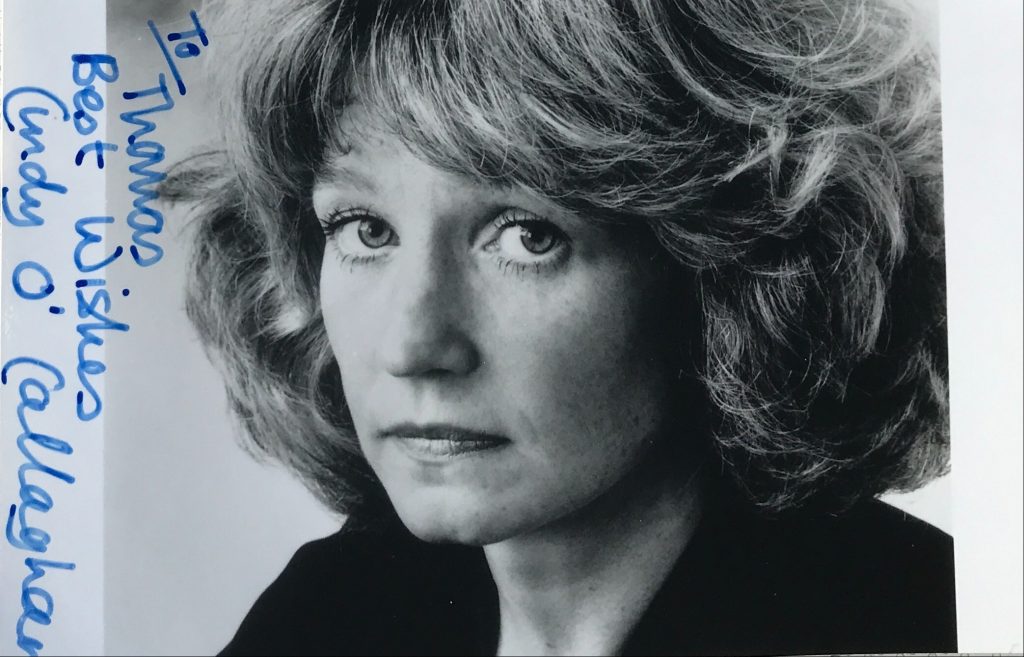
Cindy O’Callaghan was born in Ireland in 1956. In 1971 she was brought to Hollywood by Walt Disney studios to film “Bedknobs and Broomsticks” with Angela Lansbury. She returned to England to continue her studies. Her other film appearances include “Hanover Square” in 1979. In 1980 she starred in the television series about nursing entitled “Angels”.
“Wikipedia” entry:
O’Callaghan is probably most famous for her childhood role of ‘Carrie Rawlins’ in the Disney classic film Bedknobs and Broomsticks (1971), where she starred opposite Angela Lansbury and David Tomlinson. She has commented “filming Bedknobs was an incredible adventure. There I was, a working class girl from West London suddenly living on a film set in Los Angeles. My mum, who came with me, would race to the studio canteen every morning and then shake with excitement when celebrities like Rock Hudson came in to get their breakfast. I was just as star struck. I had to go to school for two hours every morning before filming, and would often be sitting in class next toDonny Osmond, whom I had a big crush on. We lived in a council house in London, but in Hollywood we had a plush apartment with its own pool. I got the role after casting directors trawled schools looking for children with London accents. I was asked to attend an audition at Pinewood, where I had to stand up and tell a funny story. I talked about how horrible my older brothers were to me. I was a big fan of Mary Poppins and couldn’t believe I was going to be in a Disney film. When I returned to Britain, my school friends were massively jealous and stopped talking to me. It marred the premiere for me. After a few unhappy months, I decided to use my fee of £3,000 to attend a private school that specialised in drama.”[2]
O’Callaghan managed to maintain—in her own words—”an averagely successful career”, doing lots of theatre as well as television work.[2] She has appeared in numerous television programmes throughout the 1970s, ’80s, ’90s and early 2000s, including ITV‘s The Bill, Casualty, Specials, Boon, Rumpole of the Bailey, Woof! and as Linda Kennedy in the BBC soap opera Triangle, among others. She has also appeared in films, including Hanover Streetand I.D.
More recently she is known for her role as Andrea Price—the “boozy” mother of Natalie Evans (Lucy Speed)—in the BBC soap opera EastEnders (1994–1995; 1999).[3] This was O’Callaghan’s second role in the soap, having previously played Stella — the mistress of Ashraf Karim — from 1989-1990.
O’Callaghan attended university in 2000, and in 2004 it was reported that she had given up acting to become a child psychologist. She commented “Four years ago, I decided to go to university and am now training to be a child psychologist. I just wanted to do something that was more fulfilling.”[2] However, O’Callaghan has appeared on television since this time, in the 2005 documentary The 100 Greatest Family Films, where she discussed the movieBedknobs and Broomsticks, along with co-stars Angela Lansbury and Ian Weighill, who played Charlie Rawlins in the film.
The above “Wikipedia” entry can also be accessed online here.
Cindy O’Callaghan (born 1956) occupies a unique niche in the British cultural consciousness. While many remember her as the wide-eyed child star of a Disney masterpiece, her later career shifted into the gritty, high-stakes world of British soap opera before she made the rare and successful transition into child psychology.
A critical analysis of her work reveals an actress who possessed a natural, “unforced” screen presence—a quality that allowed her to move from the whimsy of 1970s fantasy to the social realism of the 1990s with remarkable ease.
I. Career Overview: From “Wonderland” to Walford
1. The Disney Breakthrough (1971)
At age 14, O’Callaghan was cast as Carrie Rawlins in Walt Disney’s Bedknobs and Broomsticks. Starring alongside Angela Lansbury and David Tomlinson, she was the emotional anchor of the three children.
-
The “Rational” Child: Critically, she was noted for her ability to play “straight” against the film’s fantastical elements (flying beds and animated lions), providing a grounded reality that helped the audience buy into the magic.
2. The Journeyman Years (1970s–1980s)
Following her Disney success, she became a staple of British television.
-
Genre Versatility: She appeared in everything from the “Kitchen Sink” style drama of Play for Today to prestige literary adaptations like The Hound of the Baskervilles (1983).
-
Triangle (1981): She starred in the infamous BBC “North Sea Ferry” soap opera as Linda Kennedy. Despite the show’s technical reputation, O’Callaghan was praised for her consistent, professional delivery in difficult filming conditions.
3. The EastEnders Era (1990s)
O’Callaghan is one of the few actors to play two distinct roles on the square.
-
The “Mistress”: She first appeared as Stella (mistress of Ashraf Karim) in 1989.
-
The “Mother from Hell”: Her most famous soap role was Andrea Price, the boozy, neglectful mother of Natalie Evans. This role allowed her to fully subvert her “Disney child” image, playing a character defined by bitterness and domestic chaos.
II. Detailed Critical Analysis
1. The Evolution of “Vulnerability”
Critically, O’Callaghan’s career can be viewed as an evolution of how she projected vulnerability.
-
In the 70s: Her vulnerability was “Victorian”—expressed through wide-eyed wonder and a sense of duty (as seen in Bedknobs).
-
In the 90s: Her vulnerability became “Modern and Jagged.” As Andrea in EastEnders, she played a woman whose fragility had curdled into aggression. Critics noted her ability to make a “villainous” mother human; you could see the ghosts of her own disappointments in her performance.
2. The “Realist” Technique
O’Callaghan was an actress of economy. In an era where many British TV actors leaned toward the theatrical, she practiced a more “internalized” naturalism.
-
The Understated Reaction: In the film I.D. (1995), a gritty look at football hooliganism, she brought a necessary domestic weight to the story. She understood that in “Kitchen Sink” style dramas, the most powerful moments happen in the silences between arguments.
3. The Moral Pivot: From Acting to Psychology
Perhaps the most significant “critical” act of her career was her decision to leave it. In 2001, O’Callaghan retired from acting to become a Child Psychologist.
-
The Full Circle: Analysts often point out the poetic symmetry here. Having been a child in the “industry” herself, she dedicated her second act to protecting the mental well-being of children. This transition suggests that her acting wasn’t just a job, but a deep exploration of human empathy that she eventually turned into a clinical practice.
Iconic Performance Highlights
| Character | Work | Year | Critical Legacy |
| Carrie Rawlins | Bedknobs and Broomsticks | 1971 | The definitive “Grounded Child” in Disney history. |
| Andrea Price | EastEnders | 1994–99 | A masterclass in the “Tragic/Boozy Mother” trope. |
| Linda Kennedy | Triangle | 1981 | Showcased her “Professional Grit” in a difficult production. |
| Laura | Hanover Street | 1979 | Proved her ability to hold the screen in a big-budget war romance. |