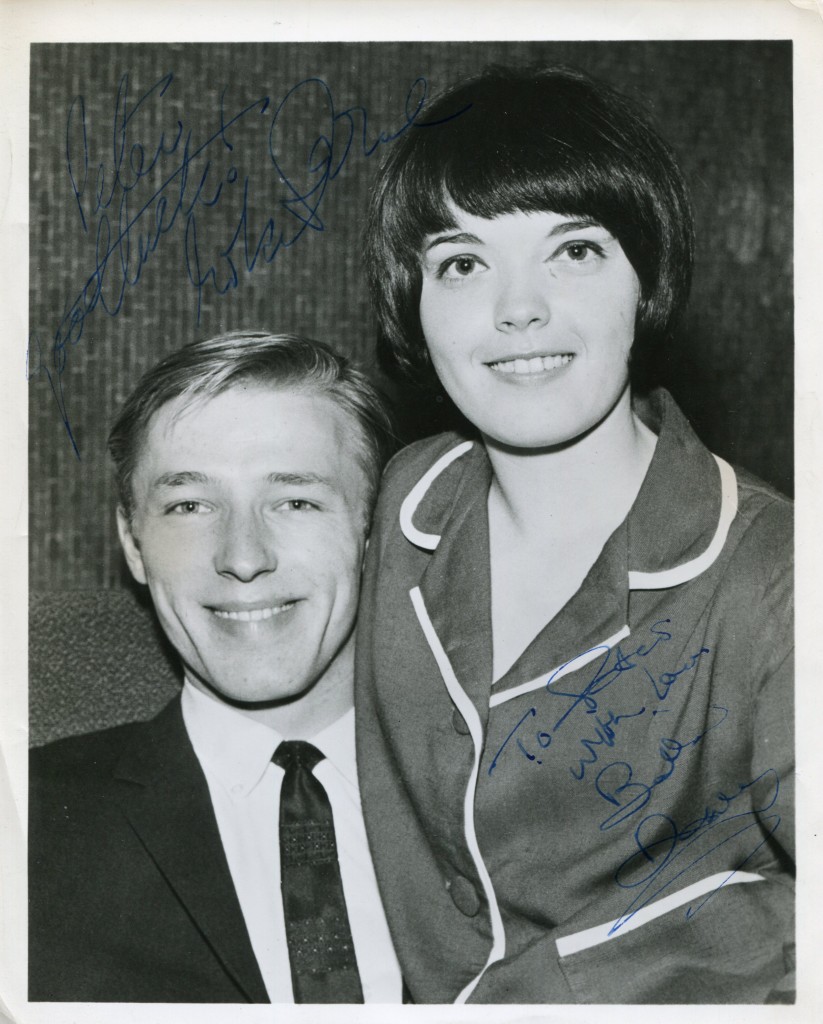
Mike Sarne (born Michael Scheuer, 1940) is one of the most eclectic and, at times, polarizing figures in British cultural history. His career is a fascinating study of the “Renaissance Man” of the 1960s—transitioning from a chart-topping pop star to a sophisticated linguist, and finally to a director whose work includes both a misunderstood avant-garde masterpiece and one of the most notorious “disasters” in Hollywood history.
Career Overview
Sarne’s trajectory is defined by a restless refusal to stay in one lane.
The Pop Phenomenon (1962–1963): Sarne became an overnight sensation with the novelty hit “Come Outside,” featuring Wendy Richard. It reached #1 on the UK charts and established him as a cheeky, “boy-next-door” persona with a distinctively posh-meets-cockney accent.
The Multilingual Actor: Educated at the School of Slavonic and East European Studies, Sarne was fluent in several languages. This made him a versatile asset for international productions, appearing in films like 633 Squadron (1944) and the epic The Moon-Spinners (1964) opposite Hayley Mills.
The Director’s Chair (1968–1970): Sarne moved into directing with the stylish, experimental Joanna (1968), which was a critical success at Cannes. This led directly to his hiring for the big-budget adaptation of Gore Vidal’s Myra Breckinridge (1970).
The Post-Hollywood Pivot: After the fallout of Myra Breckinridge, Sarne continued to work as a documentary filmmaker, actor (The Fourth Protocol, Moonlighting), and writer, maintaining a cult presence in the London arts scene for decades.
Detailed Critical Analysis
1. The “Meta” Pop Star
Critically, Sarne’s music career is often analyzed as a precursor to the “character-based” pop of the later 60s.
The Narrative Song: “Come Outside” was not just a melody; it was a scripted dialogue. Critics note that Sarne used his acting skills to play a character—the persistent suitor—rather than just “singing.” This theatricality was a departure from the earnestness of early 1960s crooners.
The Irony of Success: Sarne himself often treated his pop stardom with a degree of intellectual detachment, which some critics argue made him more relatable to the burgeoning “Mod” culture that prized coolness and irony.
2. Joanna and the Aesthetic of “Swinging London”
Joanna is Sarne’s most respected work as a director.
Visual Lyricism: Critics at Cannes praised the film for its vibrant, color-saturated palette and its fragmented, dream-like structure. It is often cited as a definitive visual document of 1968 London.
Social Boldness: As discussed earlier with actor Calvin Lockhart, Sarne was critically lauded for his casual, non-judgmental treatment of an interracial romance. He portrayed the characters as individuals rather than political symbols, which was a radical choice for the era.
3. The Myra Breckinridge Controversy
No analysis of Sarne is complete without addressing the 1970 film Myra Breckinridge.
The Clash of Visions: Hollywood expected a straightforward satire; Sarne delivered an avant-garde, non-linear fever dream filled with old movie clips and surrealist imagery. Critics at the time savaged the film, calling it “unwatchable” and “chaotic.”
Retrospective Re-evaluation: In recent years, queer cinema historians have revisited the film. Some now argue that Sarne was “ahead of his time,” attempting to create a deconstructed, postmodern film about gender identity long before the vocabulary for such a project existed in the mainstream.
4. The “Intellectual” Character Actor
In his later acting career, Sarne was frequently cast as European villains or intellectuals.
The Polyglot Edge: Because he could authentically speak Russian, French, German, and Italian, he avoided the “caricature” trap that many British actors fell into when playing foreigners. Critics noted that he brought a “lived-in” cosmopolitanism to his roles.
The “Cool” Veteran: In his appearances in 80s and 90s television and film, he often served as a “link” to the 60s era, projecting an aura of someone who had “seen it all” and survived the Hollywood meat-grinder.
Major Credits & Recognition
Project Role Significance
“Come Outside” (1962) Singer A #1 UK hit; defined the “cheeky” early-60s pop sound.
Joanna (1968) Director/Writer A critical darling of the Cannes Film Festival; a “Mod” masterpiece.
Myra Breckinridge Director One of the most famous “cult failures” in cinematic history.
The Moon-Spinners Nicola Showcased his ability to hold his own in a major Disney production.
Moonlighting (1982) Actor A well-regarded performance in a gritty, multilingual drama.