

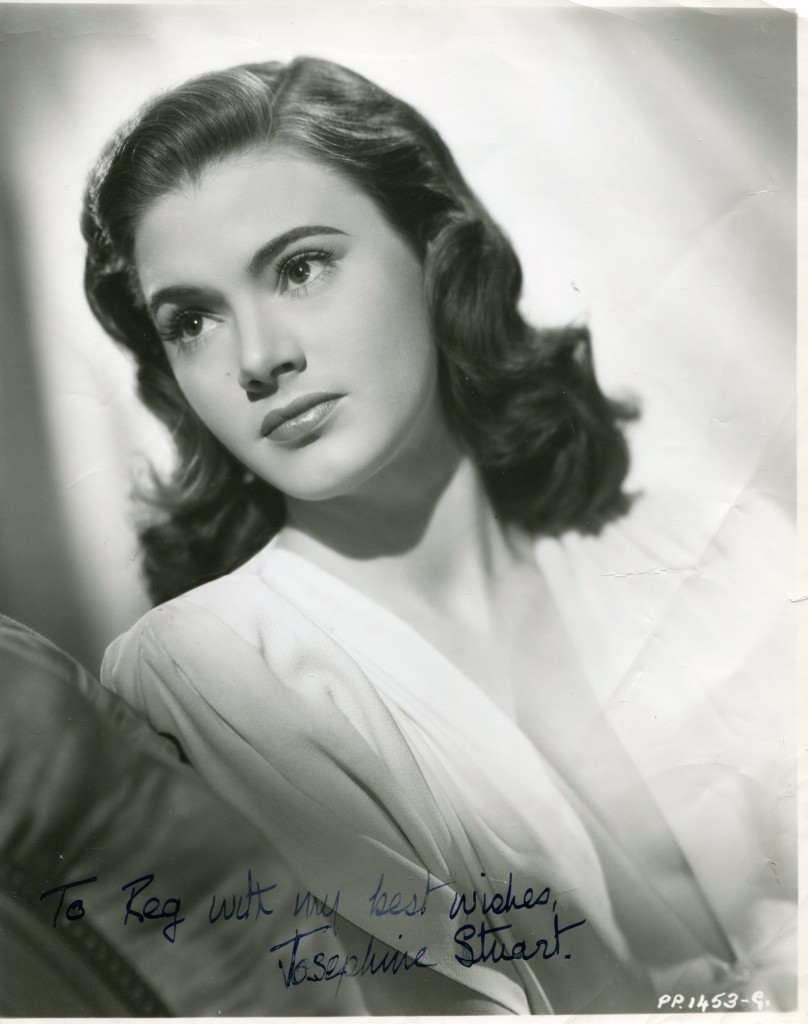
Josephine Stuart was born in 1926 in Watford. Her films include “The LOves of Joanna Godden” in 1947 with Googie Withers and Jean Kent, “Oliver Twist”, “The Weak and the Wicked” with Glynis Johns and Diana Dors and “No Time for Tears” with Sylvia Syms and Anna Neagle.
IMDB entry:
Josephine Stuart was born on November 16, 1926 in Watford, Hertfordshire, England as Celia Josephine Smith. She is an actress, known for Oliver Twist (1948), The Straw Man(1953) and Destiny of a Spy (1969).
Josephine Stuart (1926–1991) was an actress who inhabited the “Golden Age” of British cinema with a rare, luminous fragility. A critical analysis of her work reveals an actress of quiet, spiritual intensity—a performer who specialized in the “innocent caught in the storm.” While her filmography is selective, she played a pivotal role in the 18th and 19th-century period dramas of the late 1940s, providing a delicate counterpoint to the “heavier” masculine energies of the era.
In the context of the 40s Noir and 50s Western aesthetics you enjoy, Stuart represents the “Light” that the darkness of the genre is often trying to extinguish.
I. Career Overview: The Pre-Raphaelite Muse
1. The Literary Breakthrough (1947–1948)
Stuart’s career was defined by her ability to look as though she had stepped out of a classical painting.
-
Oliver Twist (1948): In David Lean’s masterpiece, she played Oliver’s Mother (Agnes). Though the role was brief and largely silent, her face became the emotional catalyst for the entire story. Critically, she was praised for her “harrowing beauty,” providing the film with its foundational sense of tragedy.
-
The Loves of Joanna Godden (1947): Working alongside Googie Withers and John McCallum, Stuart played Ellen Godden. She represented the “softer” path of womanhood in a film about female independence, showcasing her ability to hold her own against more dominant “Kitchen Sink” personalities.
2. The Gothic and Genre Specialist (1949–1953)
Stuart became a fixture in films that required a “Period Grace.”
-
The Silver Darlings (1947): A rugged, maritime drama where she played Catrine. She brought a “Maritime Noir” saltiness to the role, proving she wasn’t just a decorative figure but could handle the physical demands of location filming.
-
The House in the Square (1951): Also known as I’ll Never Forget You, this time-travel fantasy allowed her to lean into her “ethereal” quality, playing a woman from the 18th century with a haunting, timeless sincerity.
3. Transition and Retirement
Like many actresses of her generation, Stuart moved into early television (notably in The Adventures of the Scarlet Pimpernel) before stepping away from the screen in the mid-1950s. Her legacy remains tied to a specific, high-water mark of British “Prestige” filmmaking.
II. Detailed Critical Analysis
1. The “Silent” Emotionalist
Critically, Stuart is analyzed for her mastery of the “Close-Up.” * The Agnes Effect: In Oliver Twist, David Lean used Stuart’s face to establish the film’s moral compass. Analysts note that she didn’t need dialogue to convey a lifetime of suffering and hope. This aligns with the 40s Noir technique of using shadows and eyes to tell the “true” story. She possessed a “Physical Poetics”—a way of moving and looking that suggested a deep, internal life.
2. The “Foil” to Realism
In films like The Loves of Joanna Godden, Stuart provided the Essential Contrast.
-
The Domestic Anchor: While Googie Withers played the “modern” woman breaking rules, Stuart played the woman who finds strength within the tradition. Critics have noted that her performance was vital for the film’s balance; she made the “traditional” life look beautiful and dignified, which made Withers’ rebellion feel even more radical. She brought a “Soft Realism” to the screen—showing that “ordinary” goodness requires its own kind of courage.
3. The “Period” Naturalist
Unlike many actors of the 1940s who used “stagey” accents for historical films, Stuart had a natural, unforced delivery.
-
Breaking the Corset: Even in elaborate 18th-century costumes, she looked comfortable. Analysts point out that she avoided the “mannequin” style of period acting. She breathed life into the costumes, making the characters feel like people you might meet on a countryside walk rather than figures in a history book.
Iconic Performance Highlights
| Work | Role | Year | Critical Achievement |
| Oliver Twist | Oliver’s Mother | 1948 | Defined the “Tragic Muse” for British cinema. |
| The Loves of Joanna Godden | Ellen Godden | 1947 | Provided the “Moral and Emotional Balance” to a major drama. |
| The Silver Darlings | Catrine | 1947 | Showcased her ability to play “Rugged, Rural Resilience.” |
| The House in the Square | Anne Pettigrew | 1951 | Established her as the “Face of Timelessness |


Comments
Anna Bowness-Park
Josephine Stuart was not married to Guy Green. Mr Green was a camera man on the set of Oliver Twist, but they never even dated. Josephine Stuart married Gerard Guillaumat, a French actor. They divorced in 1957. I should know, as I am Josephine and Gerard’s daughter.
Liam
Apologies Anna. I have corrected my blog. Your mother was a beautiful actress.