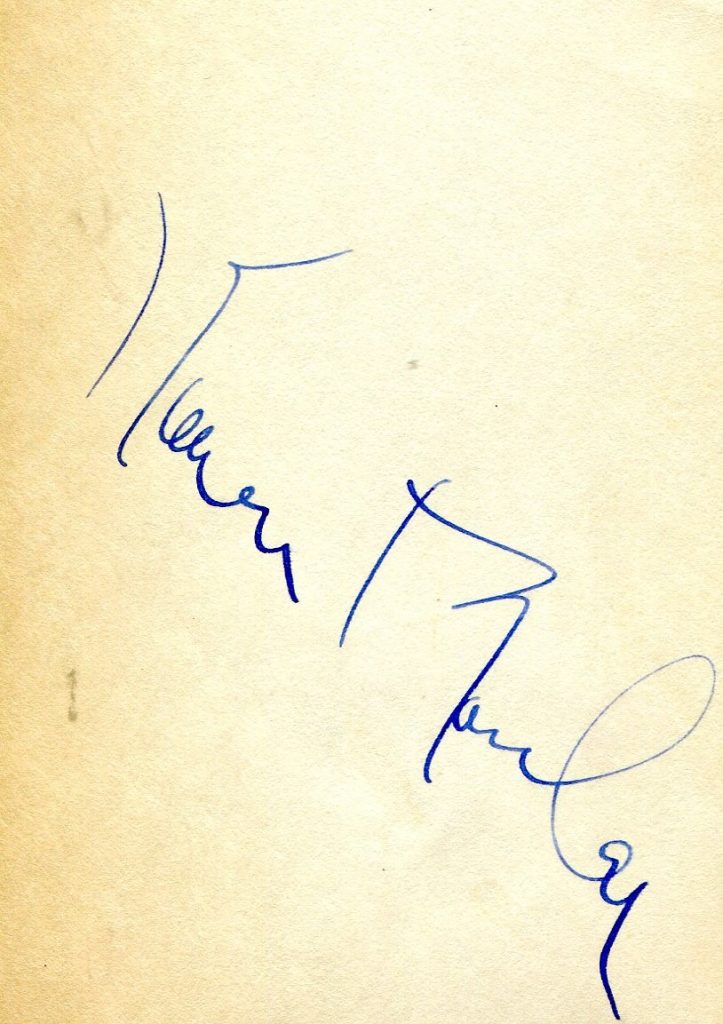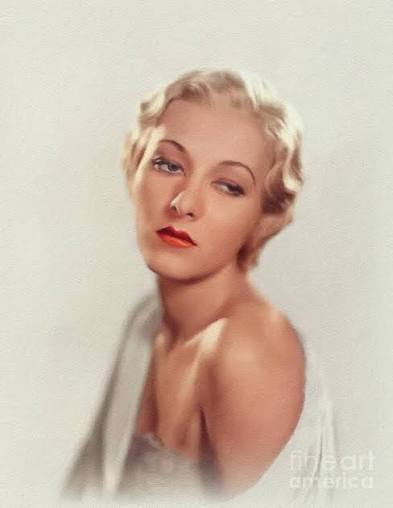


Karen Morley was born in 1909 in Iowa. She was awarded a contract with MGM and was in such films as “Mata Hari” with Greta Garbo in 1931, “The Mask of Fu Manchu”, “Dinner At Eight” with Marie Dressler and “Pride and Prejudice” with Greer Garson and Maureen O’Sullivan. She died in 2003.
Ronald Bergan’s “Guardian” obituary:
A month after director Elia Kazan received the Academy Award for lifetime achievement in 1999 (despite having named names before the House UnAmerican Activities Committee – HUAC), the San Francisco Film Festival honoured Karen Morley, whose career as an actress suffered from “friendly” witnesses. Morley, who has died aged 93, was called before Congress in 1952, but invoked the Fifth Amendment when asked if she had ever been a member of the Communist party. Actors Sterling Hayden and Robert Taylor were among those who denounced her.
She was born Mabel Linton in Ottumwa, Iowa, and moved with her foster family to California in her teens. After graduating from UCLA, she gained some acting experience at the Pasadena Community Playhouse. She broke into movies in 1930, when asked to read lines to actors being tested for the Garbo movie, Inspiration. She was cast, and signed up by MGM as Karen Morley.
In 1932, one of her busiest years, Morley appeared with Garbo in Mata Hari; she had leading roles in Arsene Lupin as gentleman-thief John Barrymore’s love interest; and played three femmes fatales , for which she is most remembered. In Washington Masquerade, she was a sexy lobbyist who married and corrupted a senator (Lionel Barrymore). In John Ford’s uncharacteristic Flesh, Morley trapped wrestler Wallace Beery into marriage; she then took a lover, had a baby by him, and passed it off as her husband’s. She was sympathetic when she declared her love for Beery, in prison for killing her lover. In Howard Hawks’ Scarface, there was little sympathy for her as Poppy, the blonde moll of a minor hoodlum. “She don’t like anybody but me,” he boasted, deluded; she soon made eyes at big gangster Paul Muni. Also in 1932, in The Mask Of Fu Manchu, her loveliness stimulated villainous Boris Karloff’s appetite for evil. The film was co-directed, uncredited, by the Hungarian-born Charles Vidor. He married Morley that year, keeping it secret from studio and press: they later had a son.
Vidor introduced her into politics, especially to anti-fascist groups. She left MGM after Dinner at Eight (1933) in which she shone as the forgiving wife of a philandering doctor, and went on to appear in Our Daily Bread (1934), an independent production about an attempt to start a farming cooperative. The film, directed by King Vidor (no relation), and called “pinko” by the Hearst press and “capitalist propaganda” in the Soviet Union, was a brave, raw attempt to inject contemporary issues into Hollywood cinema. As much as she could, Morley chose films with some political content such as Black Fury (1935) about racketeers muscling in on the Mine Worker’s Union, and The Last Train From Madrid (1937) in which she was a passenger fleeing the civil war. In 1940, Morley returned to MGM for one film, Pride And Prejudice. Soon after, she joined a tobacco workers’ organising drive in the South, having followed leftwing actor Lloyd Gough there. They married after her divorce from Vidor in 1943.
Morley made a number of minor films in the 1940s, while active as one of the few radicals in the Screen Actors Guild. She organised a strike, but it broke when Guild members, including Frank Sinatra and Robert Mitchum, crossed the picket lines. In 1951, she appeared in M, the remake of Fritz Lang’s German classic. Morley, with Joseph Losey, the director, Waldo Salt, the co-writer, and other members of the cast, was blacklisted in 1952. Lloyd Gough was also subpoenaed and blacklisted. Because Gough had played the important part of the heavy in Lang’s Rancho Notorious (1952), he could not be cut from the film, but he was not named in the final credits. Morley and Gough struggled to make a living over the next years, with a few parts in theatre and television. “It was really murder to find work after being blacklisted, for all actors who were prominent, because their faces were well known,” Morley explained. “People in the theatre like to say that it didn’t have a blacklist, and technically it didn’t. But people went out the back door when I tried to look for work in the theatre.”
In 1954, Morley, retired from acting, ran unsuccessfully for lieutenant-governor of New York State on the American Labor Party ticket. Gough worked in television series; he died in 1984.
· Karen Morley (Mabel Linton), actor, born December 12 1909; died March 8 2003