


Tom Tryon TCM Overview
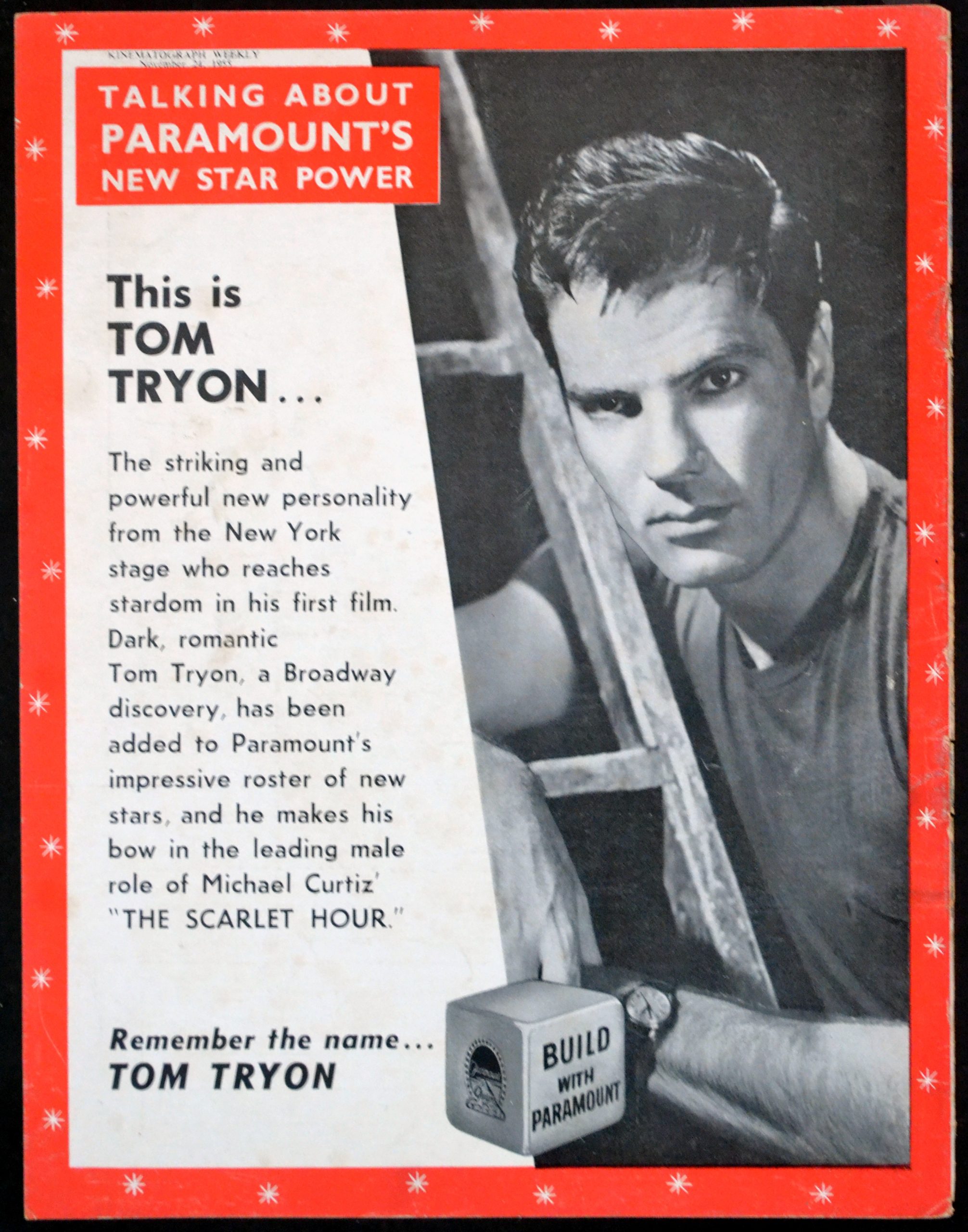
Tom Tryon had a successful career in film when he decided to retire from movies and he became a very popular author of best-sellers. He was born in 1925 in Hartfort, Connecticut. His first film was “The Scarlet Hour”.
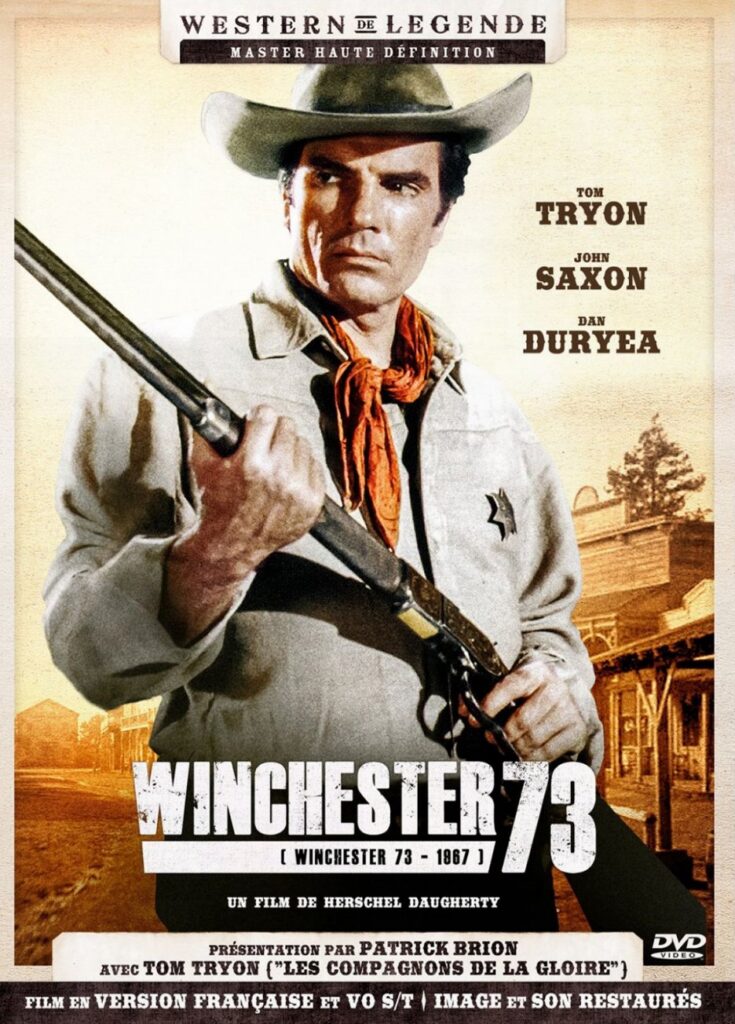
He was very effective opposite Diana Dors in “The Unholy Wife” in 1957. He starred in many Westerns including “Three Violent Men”, “Texas John Slaughter”, “The Glory Guys” and “Winchester 73”.
He also became identified with the cult classic “I Married a Monster from Outer Space”. In 1963 Otto Preminger surprisingly chose him to play the lead in the big-budget movie “The Cardinal”.
He also starred in Preminger’s “In Harm’s Way”. Preminger a difficult taskmaster made film making difficult for Tryon.
His interest in acting waned and he took up a new and extremely successful career as a writer. His books include “The Other”, “Harvest Home” and “Fedora”, all of which were subsequently filmed.
Tom Tryon died in 1991 in Los Angeles.Tall, ruggedly handsome leading man of the 1950s and 60s who after a 16-year career gave up acting in 1971 to write the best-selling novels “Crowned Heads” and “Harvest Home”


. After beginning in a stock theatre company as a set painter and assistant manager, and later becoming a production assistant with NBC-TV, the Yale-educated Tryon entered film in 1955 with “Scarlet Hour”.
He appeared in mostly forgettable fare including “I Married a Monster from Outer Space” (1958) (as a stone-faced alien), and as the title character in the 1958 Walt Disney TV series “Texas John Slaughter”. The height of his acting career was the starring role in Otto Preminger’s “The Cardinal” (1963). In 1971, Tryon wrote the highly popular, supernatural thriller “The Other”, which he adapted to the screen the following year, and then switched full time to his eventually more successful writing career.


His novel “Harvest Home” was made into a 1978 TV movie “The Dark Secret of Harvest Home”, and his “Crowned Heads” was adapted in part for the 1978 Billy Wilder film, “Fedora”.
The above TCM overview can also be accessed online here.
TCM Overview:
Blog on Tom Tryon:
It was Noel Coward’s partner, Gertrude Lawrence, who encouraged Tom to try acting. He made his Broadway debut in 1952 in the chorus of the musical “Wish You Were Here.” He also worked in television at the time, but as a production assistent. In 1955 he moved to California to try his hand at the movies, and the next year made his film debut in “The Scarlet Hour” (1956). Tom was cast in the title role of the Disney TV series “Texas John Slaughter” (1958) that made him something of a household name.
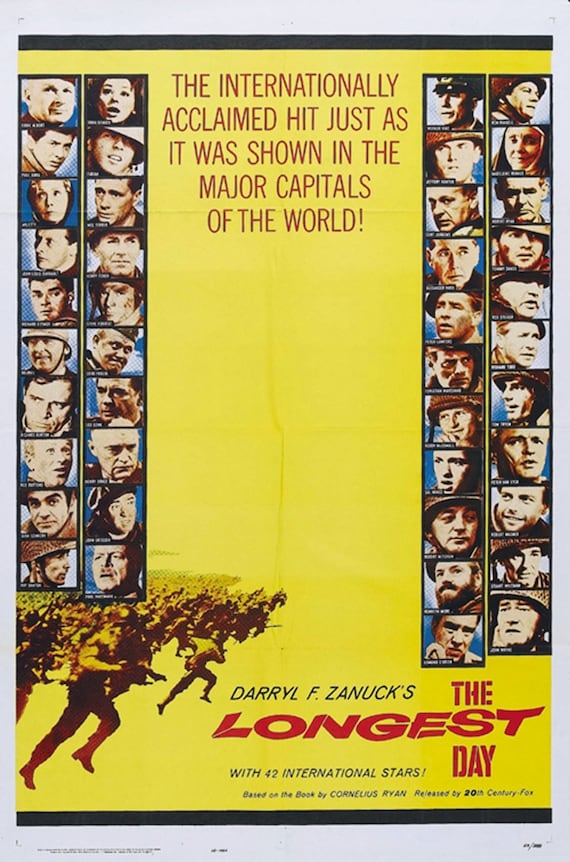
He appeared in several horror and science fiction films: “I Married a Monster from Outer Space” (1958) and “Moon Pilot” (1962) and in westerns: ‘Three Violent People’ (1956) and ‘Winchester ’73’ (1967). He was part of the all-star cast in ‘The Longest Day’ (1962), a film of the World War II generation, credited with saving 20th Century Fox Studios, after the disaster of ‘Cleopatra.” He considered his best role to be in ‘In Harm’s Way’(1965), which is also regarded as one of the better films about World War II.
While filming the title role in ‘The Cardinal’ (1962), Tom suffered from Otto Preminger’s Teutonic directing style and became physically ill. Nevertheless, Tom was nominated for a Golden Globe award in 1963. He appeared with Marilyn Monroe in her final film, “Something’s Got to Give” (1962), but the studio fired Monroe after three weeks, and the film was never finished. That experience, along with the “Cardinal” ordeal, left Tom wary of studio games and weary at waiting around for the phone to ring.
After viewing the film “Rosemary’s Baby” (1968) Tom was inspired to write his own horror novel, and in 1971 Alfred Knopf published “The Other.” It became an instant bestseller and was turned into a movie in 1972, which Tom wrote and produced. Thereafter, despite occasional film and TV offers, Tom gave up acting to write fiction fulltime. This he did eight to ten hours a day, with pencil, on legal-sized yellow tablets. Years later, he graduated to an IBM Selectric.

The Other was followed by Lady (1975) which concerns the friendship between and eight-year-old boy and a mysterious widow in 1930s New England. His book Crowned Heads became an inspiration for the Billy Wilder film “Fedora” (1978), and a miniseries with Bette Davis was made from his novel Harvest Home (1978). All That Glitters (1986), a quintette of stories about thinly disguised Hollywood greats and near-greats followed. Night of the Moonbow (1989), tells of a boy driven to violence by the constant harassment he endures at a summer camp. Night Magic, about an urban street magician with wonderous powers, written shortly before his death in 1991, was posthumously published in 1995. The dust jackets and end papers of Tom’s books, about which he took unusual care, are excellent examples of his gifts as an artist and graphic designer, further testimony to the breadth of his talents.
Blog can be accesssed online here.
Career overview
Tom Tryon (1926–1991) had a two‑stage public life: first as a handsome, urbane film and television actor in the 1950s–60s, and then as a successful novelist and occasional screenwriter in the 1970s and 1980s. His career is interesting because it maps a conscious artistic pivot—from performer within Hollywood’s star system to an author who helped shape modern American psychological horror and literary suspense.
Career overview
Acting career
Early work and persona: Tryon began as a stage actor and moved into film and television in the 1950s. He cultivated a polished, clean‑cut leading‑man image—wry, elegant and physically striking—which suited studio dramas, historical pictures and series television. He appeared regularly on dramatic TV anthologies and popular shows of the era, earning a steady professional profile rather than megastardom.
Film roles and type: In features he was often cast as the approachable romantic lead or as an intelligent, somewhat enigmatic supporting figure. Directors used him when a character required charm with an undercurrent of reserve; his on‑screen manner combined classical composure and a capacity for understatement.
End of acting phase: By the mid‑1960s Tryon largely withdrew from acting. He later expressed dissatisfaction with the kinds of roles available and a desire to devote himself to writing, a transition he successfully executed.
Writing career
Breakthrough as a novelist: Tryon reemerged in the early 1970s as a novelist. His first major success was The Other, a tightly constructed psychological/horror novel that became a bestseller and remains his best‑known book. It established him as a writer who could combine literary control with genuinely eerie, lingering dread.
Subsequent fiction and themes: He followed with other works in the dark folk‑horror and psychological‑suspense register—most notably Harvest Home—which further cemented his reputation for atmospheric, slow‑burn storytelling about community, ritual, repression and the fragility of identity. His novels often find terror in intimate domestic or rural settings rather than in overt supernatural spectacle.
Later output and adaptations: Several of Tryon’s books were adapted for film or television, and he continued writing novels and shorter works through the 1970s and 1980s. He also wrote scripts and worked intermittently with producers, bringing a novelist’s structural discipline to genre material.
Critical analysis
Acting: strengths and limitations
Strengths: As an actor Tryon’s principal assets were refinement and inwardness. He conveyed subtle emotional states through small gestures and vocal economy, which made him convincing in roles that required restraint rather than theatrical excess. On television he was reliable and camera‑savvy; in film he could lend an aura of garden‑variety dignity or mild menace when scripts asked for it.
Limitations: Tryon never developed into a major star with broad range. His screen persona—handsome, controlled and somewhat aloof—served him well in a certain set of parts but also made him vulnerable to typecasting. That narrow casting partly explains why he left acting: the roles on offer did not match his evolving artistic ambitions.
Writing: strengths and limitations
Strengths: Tryon’s fiction is notable for craft, atmosphere and psychological precision. He preferred subtle, cumulative menace: slow revelations, careful character work and an eye for how ordinary settings can conceal social or metaphysical rot. His prose is lucid and controlled, often literary in tone while remaining accessible—helping his books reach both critical notice and a mass readership. The way he staged communal rituals, family secrets and the breakdown of identity places him in a lineage with mid‑century American psychological horror and folk‑horror writers who used locality and social pressure as sources of dread.
Signature themes: recurrent motifs include duplicity of appearance vs. reality, the costs of conformity, the persistence of repressed trauma, and the thin line between civilized veneer and barbarism. He frequently explored how small communities police behavior and the psychic price paid by outsiders or those who resist.
Limitations: Critics sometimes faulted Tryon for a certain plotting predictability in later works or for relying on gothic‑tinted conventions. For readers who prefer visceral or spectacular horror, his slow, literary approach can feel paced too cautiously. Also, after his initial bestsellers, some later novels attracted more mixed critical response—an ebb common to many popular novelists.
Overall significance and legacy
Unusual twofold career: Tryon’s importance lies partly in the rare, successful reinvention from actor to novelist. He is a notable example of an entertainer who left a visible screen career to produce a second, artistically respected body of work.
Contribution to genre literature: His novels—especially The Other and Harvest Home—are cited in histories of American horror and suspense for their elegant psychological focus and for extending folk‑horror concerns into American (often rural or small‑town) settings.
Cultural footprint: While his name may not be at the top tier of either Hollywood stars or canonical novelists, his books retain a devoted readership and are often rediscovered by fans of psychological horror and literate genre fiction. His capacity to create creeping dread with restrained prose distinguishes him from more sensational writers.