



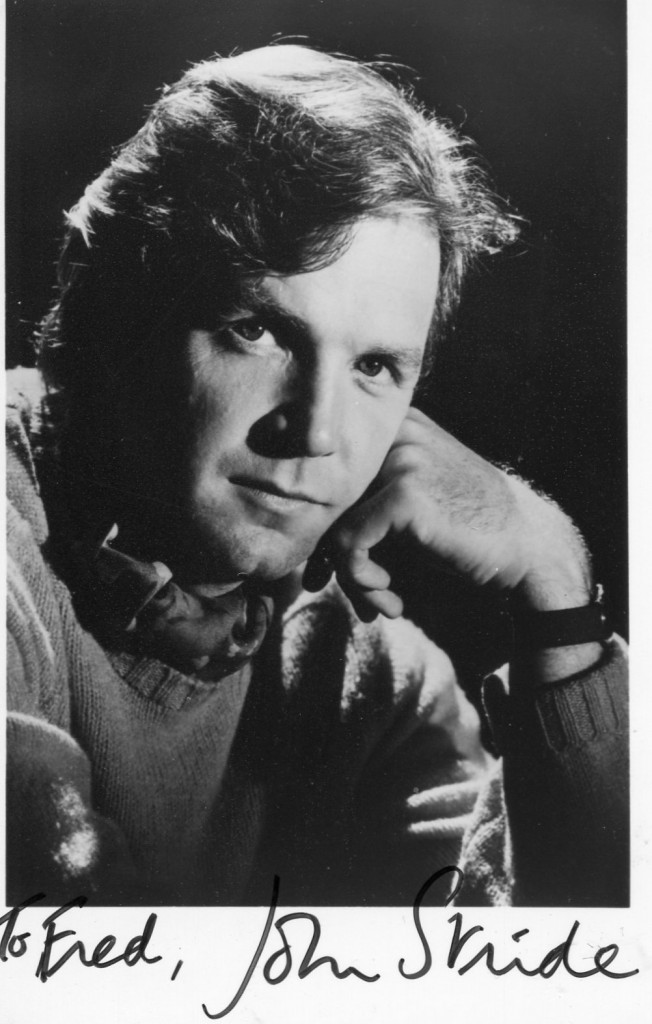
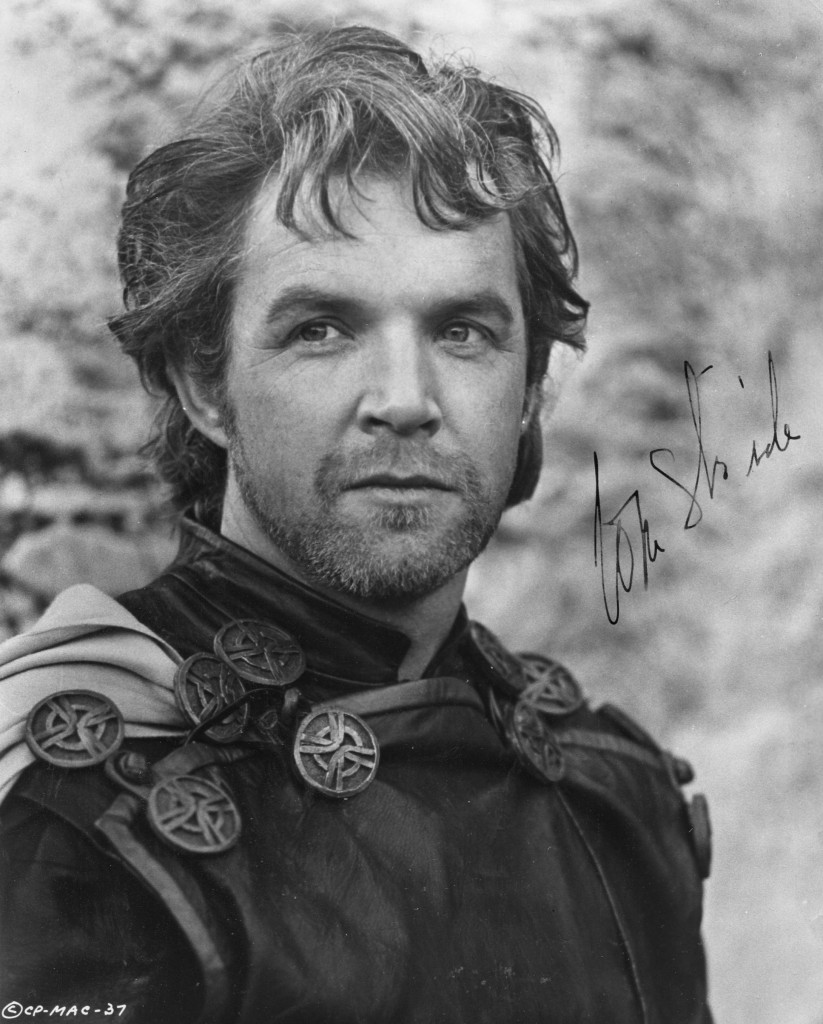
John Stride obituary in “The Guardian” in 2018
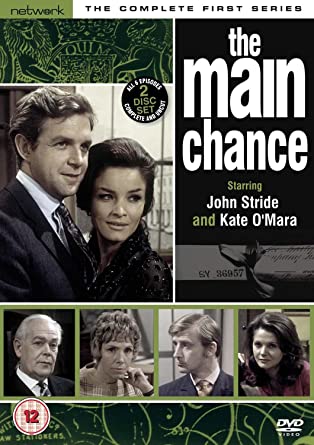
John Stride, who has died aged 81, was a golden boy of the early years of the National Theatre – he was a founder member of Laurence Olivier’s company at the Old Vic, appearing as Fortinbras in Hamlet, the inaugural production starring Peter O’Toole in 1963 – and a television star of some magnitude, playing the promiscuous lawyer David Main in four series of The Main Chance between 1969 and 1975.
His pre-National breakthrough was as Romeo to Judi Dench’s Juliet at the Old Vic in 1960. Kenneth Tynan hailed Franco Zeffirelli’s production as “a revelation, perhaps a revolution,” in that the lovers’ passion was, for the first time, so young, immediate, contemporary and palpable. The play was re-born.
And Stride double-booked his place in the history books with the first professional performance of Tom Stoppard’s Rosencrantz and Guildenstern Are Dead in 1967, playing the garrulous, amiably philosophical Rosencrantz opposite Edward Petherbridge’s irritable and sarcastic Guildenstern; in the opening coin-tossing scene of a play that placed the attendant lords centre stage with the tragedy of Hamlet as its scenery, Stride had called 85 “heads” in a row – correctly. The show, said the critic Peter Lewis, came out of the dark like a spot-lit jewel full of vibrations.
Stride could be brusque off stage, said Petherbridge, but was always impeccable on. He was a strikingly good-looking juvenile, with cherubic features, fine bearing and a voice that was God-given, according to another friend and contemporary, the actor David Weston: “John spoke verse as well as anyone I’ve ever heard.” But after his great bulge of success in the 1970s, Stride’s career foundered in the 80s and petered out with a florid performance as an ageing actor trying to make a come-back in Melvyn Bragg’s King Lear in New York, at the Chichester Festival theatre in 1992.






It was as though, starting as Peter Pan, a “Tennant’s boy” in the West End – hired by the all-powerful Binkie Beaumont of HM Tennant – and then Romeo and a National Theatre star, he failed to adjust to an older, middle-aged model.
He was born into a working-class family in South Norwood, south-east London, one of the five children of Alfred, a gardener and mechanic, and his wife Margaret (nee Prescott). He won a place at Alleyn’s school, Dulwich, then a direct grant grammar school, where he played soccer and water polo to high standards; he had extremely large hands, which earned him the nickname “Navvy”.
The key figure in his early life was the Alleyn’s English and drama master Michael Croft, who would later found the National Youth Theatre, in 1956. In a school production in 1952, Croft cast Stride as Hamlet, followed by Macbeth, and then as Antony. As a result, Stride won a scholarship to Rada – to the disapproval of his parents – alongside Alan Bates and O’Toole. He did his national service for two years with the Royal Artillery before playing a season at the Liverpool Playhouse in 1957 and making his West End debut in 1959 in Peter Shaffer’s Five Finger Exercise, a role he took over from Brian Bedford.
He then joined the Old Vic where his roles, apart from Romeo, included Lysander, Prince Hal and Gratiano in The Merchant of Venice. With the Old Vic he made his New York debut in 1962 as Malcolm in Macbeth and as Romeo. With Olivier’s new National, he was a fine Cassio in Othello (with Olivier and Maggie Smith), Dunois in Joan Plowright’s Saint Joan, Valentine in an exquisite production of Congreve’s Love for Love, Andrei in Three Sisters and the title role in Brecht’s version of Marlowe’s Edward II.
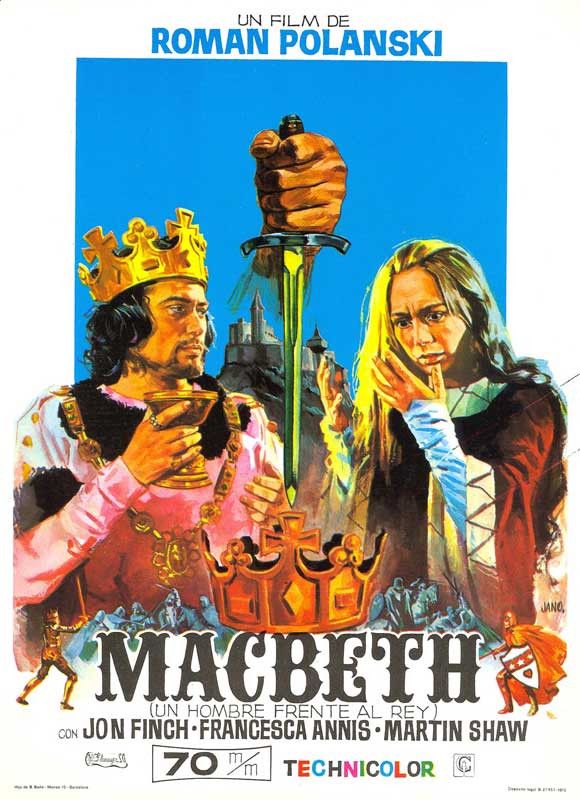
As he eased away from the National, the film career he had started in 1963 as a sympathetic barman in Bitter Harvest (1963) – starring Janet Munro as a Welsh innocent abroad in London, and based on a Patrick Hamilton novel – picked up with roles as Ross in Roman Polanski’s Macbeth (1971), with Jon Finch in the title role and Francesca Annis as a stunning, nakedly sleep-walking Lady Macbeth, John Wayne in Douglas Hickox’s Brannigan (1975) and with Gregory Peck and Lee Remick in Richard Donner’s The Omen (1976), in which he played a psychiatrist.
But in none of these films did he make the same impact as in The Main Chance on television, and that is where he stayed, with a couple of significant sorties into the commercial theatre: co-starring with Eileen Atkins in Marguerite Duras’ Suzanna Andler in 1971 at the Yvonne Arnaud, Guildford; and with Vanessa Redgrave and Jeremy Brett in Michael Blakemore’s superb 1973 West End revival – retrieval, really – of Noël Coward’s Design for Living at the Phoenix; this “disgusting, three-sided erotic hotchpotch”, as one of the “excluded” characters in the play dubs it, as restored to the repertoire as a modern classic.
His TV follow-up to The Main Chance was Wilde Alliance (1978), in which he and Julia Foster were a husband and wife team of amateur detectives, but it lasted for only one series. After playing Bluntschli in Bernard Shaw’s Arms and the Man at the Oxford Playhouse in 1976, he became a stranger to the stage until the Bragg play in Chichester. And in this same year, 1992, he scored heavily, for the last time on television, as two debauched characters: a lecherous businessman, Sir Bernard Bellamy, in Fay Weldon’s Growing Rich; and as the promiscuous Welsh “media type” Alun Weaver in Andrew Davies’s adaptation of Kingsley Amis’s The Old Devils.
By the time he played Bragg’s actor-laddie, he seemed to be a caricatured, bloated version of his former self. The play, anyway, was a poor re-tread of Ronald Harwood’s The Dresser (1980), in which Freddie Jones (and, on film, Albert Finney) played a version of Donald Wolfit as Lear during the blitz; Stride’s Lear in modern Manhattan, besieged by two wives, a strident television gossip journalist and a drug addict daughter, was too forced a dramatic analogy, and Stride himself seemed to have morphed into a snowy-haired, bibulous and bulging version of Bragg’s old director buddy Ken Russell. It was, nonetheless, a memorable and agreeably growling performance, and approved by the critics, who were collectively delighted to see him back in action.t
Stride was twice married, first in 1958 to his Rada contemporary Virginia Thomas (the marriage ended in divorce) and then, in 1972, to the actor April Wilding.
She died in 2003 and there are friends who say he never fully recovered from this blow. His last years were spent in a nursing home near Oxford. He is survived by two daughters from his first marriage and one from his second.
• John Edward Stride, actor, born 11 July 1936; died 20 April 2018

Comment
roslyn slade
Hi. Do you sell autographed photos or are you just informing readers of your collection.